

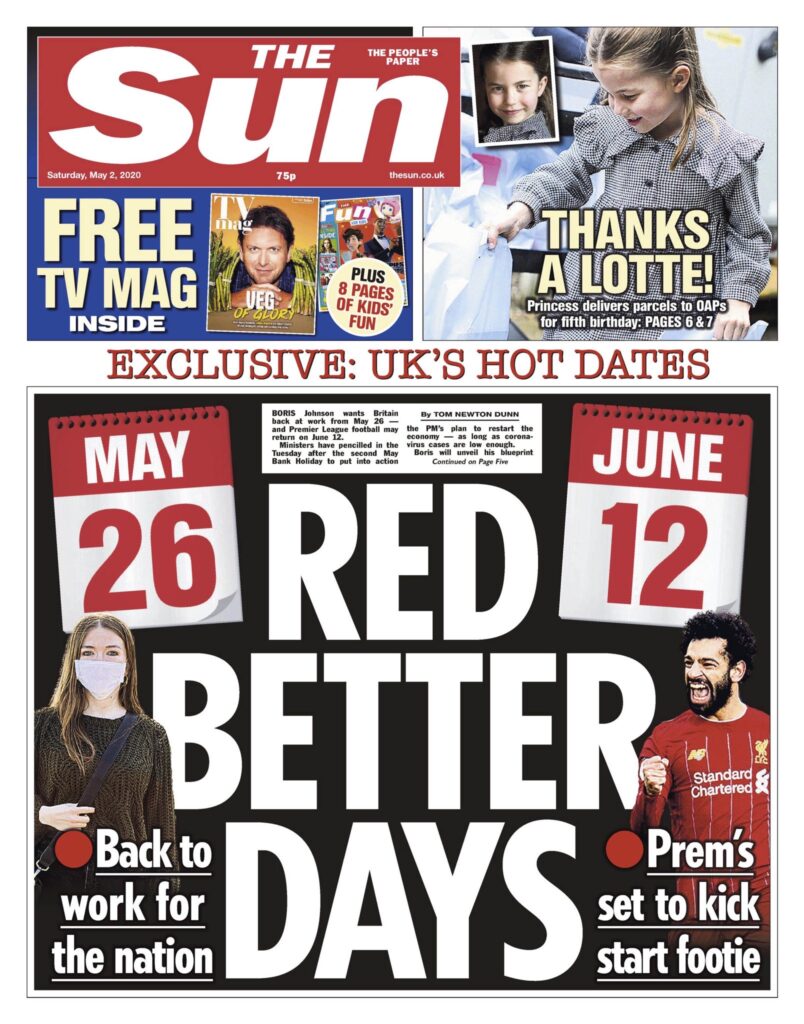
The Sun leads with two important dates: the date we’ll return to work (May 26th) and the date the Premier League will resume behind closed doors (June 12th). May 26th is the day after a Monday bank holiday and according to the Sun‘s Political Editor Tom Newton Dunn the date Boris is going to name as back-to-work day next Thursday. That makes sense because May 7th is the day the Government and its scientific advisors are reviewing the lockdown. According to Newton Dunn, the announcement will give offices, shops and some factories two-and-a-half weeks to install new government social distancing measures, such as perspex screens and gaps between desks, as well as give the public enough time to overcome their “coronaphobia”. That’s the Sun‘s word for the fact that two-thirds of the public are now too scared to leave the house, as revealed in a poll for Ipsos Mori.
Will the Government expect us to observe the two metre social distancing rule when restrictions are eased? Possibly not, according to the Telegraph. It’s main front page story says the Government has asked the Scientific Advisory Group for Emergencies (SAGE) to look again at whether people need to stay two metres apart. If that rule is relaxed it will make reopening the country easier, not least because it’s unenforceable in schools, as Katharine Birbalsingh, the head of Michaela Community School, has pointed out. Christopher Hope, the Telegraph‘s political editor, has more details on the plans the Government is considering, which include staggered start times in offices and factories, a delayed lunch hour to reduce the likelihood of overcrowding in town centres, and temperature screening of employees as they turn up for work each day.
The Government’s plans for restarting the economy will almost certainly include a ‘test, track and trace’ programme, particularly after Matt Hancock hit his target yesterday of testing 100,000 people a day by the end of April. The number on April 30th was 122,347, but the Guardian claims this was inflated by including 39,000 test kits that had been sent to households and satellite testing locations. No evidence those kits have even arrived, let alone been used.
Among those industries hit worst by the lockdown is the aviation industry, with the Mail reporting that in the town of Crawley near Gatwick up to 50% of jobs are at risk of being lost or furloughed. British Airways has already announced it plans to make 12,000 staff redundant and its parent company IAG has just secured a £900 million loan from the Spanish Government. Meanwhile, Rolls Royce is cutting up to 8,000 jobs. Crawley Borough Council is among several local authorities that may have to file for bankruptcy, along with Liverpool City Council and Windsor and Maidenhead Borough Council. Perhaps no surprise then that Simon Dolan, the businessmen who’s hoping to challenge the lockdown in the High Court, owns an aircraft charter business. The Mail has more details.
As the lockdown eases and we survey the economic wreckage, more and more people will start asking whether the cure was worse than the disease. And the evidence that the more modest social distancing measures put in place by the Government on March 16th were sufficient to “flatten the curve” continues to mount. A reader has sent me this interesting graph showing the use of mass transport in London, Birmingham and Manchester declining rapidly before the lockdown was imposed:
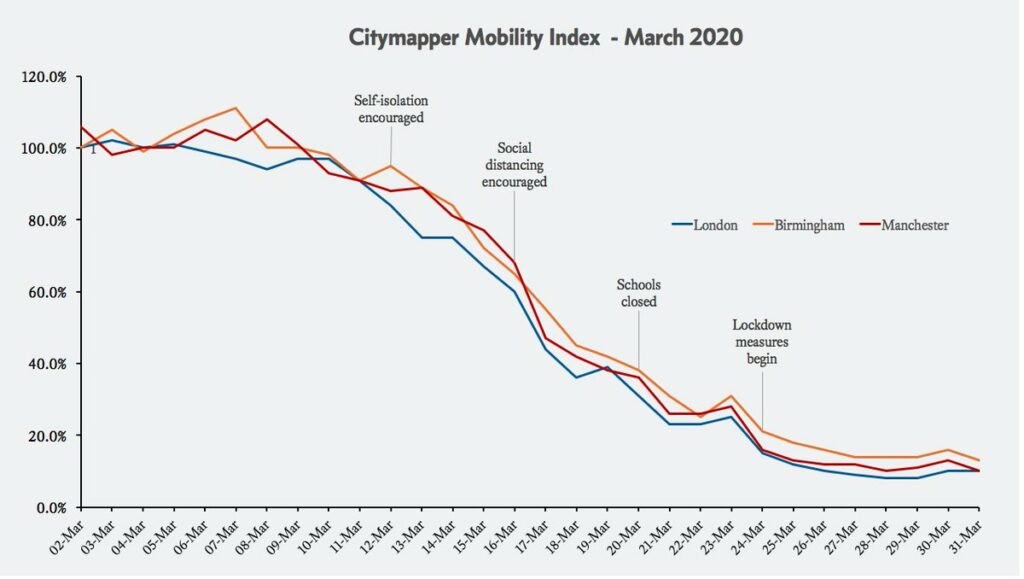
This is just one data point, but if you want to read a full survey of the evidence that lockdowns don’t work I recommend this paper by Thomas Meunier entitled ‘Full lockdown policies in Western Europe countries have no evident impacts on the COVID-19 epidemic‘. Here’s what the abstract says:
This phenomenological study assesses the impacts of full lockdown strategies applied in Italy, France, Spain and United Kingdom, on the slowdown of the 2020 COVID-19 outbreak. Comparing the trajectory of the epidemic before and after the lockdown, we find no evidence of any discontinuity in the growth rate, doubling time, and reproduction number trends. Extrapolating pre-lockdown growth rate trends, we provide estimates of the death toll in the absence of any lockdown policies, and show that these strategies might not have saved any life in western Europe. We also show that neighboring countries applying less restrictive social distancing measures (as opposed to police-enforced home containment) experience a very similar time evolution of the epidemic.
One sentence in Meunier’s conclusion jumped out: “As a concluding remark, it should be pointed out that, since the full lockdown strategies are shown to have no impact on the epidemic’s slowdown, one should consider their potentially high inherent death toll as a net loss of human lives.” That’s a reference to those who’ve died, and will die, as a direct result of the lockdowns. We won’t know that number for some time – I predict we’ll still be debating it in 50 years time – but we can take a stab at estimating how many people have died as a result of the UK lockdown to date and Hector Drummond has done precisely that in the Critic. He analysed the excess deaths in Weeks 14 to 16, as documented by the ONS, that weren’t recorded as deaths from COVID-19 to see if they were undiagnosed COVID-19 deaths or deaths from other causes. If the latter, that suggests the lockdown itself is partly to blame. Of the excess deaths in that period, 7,486 were not attributed to COVID-19. Those who claim the “real” death toll from coronavirus is much higher than the official figures suggest take it for granted that these were undiagnosed COVID-19 deaths, but if they were you’d expect the ratio of men to women in that figure to be roughly 60:40, a skew that holds true for all Covid deaths. But when Drummond looked at the non-Covid excess deaths in Weeks 14 to 16 he found the ratio was roughly 50:50, which suggests that at least some of them weren’t undiagnosed COVID-19 deaths. Well worth a read.
Another unintended consequence of the lockdown may be that it has interrupted the natural evolution of the virus whereby it would have become progressively milder if we’d stuck with mitigation. Dr John Lee, a retired consultant pathologist, has a fascinating piece in this week’s Spectator in which he poses that question. Dr Lee points out that all viruses mutate, and a rapidly-spreading one like SARS-CoV-2 typically becomes less harmful as it changes because this helps it survive. After all, if the virus kills too many of its hosts, it is more likely to die out, whereas if it becomes milder, it spreads further. He thinks it’s likely there are dozens of different strains of SARS-CoV-2 currently in circulation, some quite mild, others deadly. What if the Government’s suppression strategy has meant stopping those people with the milder versions of the virus from circulating and, at the same time, herding those with the deadlier versions into hospitals where they can infect other patients and NHS staff? It could be, says Dr Lee, that the lockdown is giving the nastier strains of the virus a helping hand, thereby slowing the tendency of this new disease to get milder with time.
As we tot up the unintended consequences of lockdowns across the world, it’s worth bearing in mind that the quarantining of entire countries for extended periods of time is a new and untried strategy for managing a pandemic. Historically, there are very few examples of lockdowns being used before. The earliest historical example I can find is Florence in 1631, when an outbreak of the plague killed 12% of the population. More recently, Mexico in 2009, during the first days of an H1N1 influenza outbreak, isolated those suspected of being infected, closed schools, banned public gatherings and cancelled a regional soccer tournament. But those measures weren’t replicated in other countries and Mexico abandoned them after 18 days, partly due to the mounting social and economic costs.
We’re often told by lockdown enthusiasts that those US cities that introduced extreme social distancing measures during the Spanish flu pandemic experienced fewer deaths than those that didn’t. But those measures stopped well short of a full lockdown. For instance, in St Louis, which is often held up as a model of how to manage the current pandemic, churches and schools were closed, business hours were restricted and people were ordered to wear mask in public, but the city never issued a stay-at-home order and only cancelled business activity entirely for about forty-eight hours.
Also worth noting that lockdowns weren’t even suggested during America’s deadliest bouts of seasonal flu since 1919. In 1967, flu killed about 100,000 Americans and in 1957 it killed about 116,000. As of yesterday, the COVID-19 death toll in the US was just under 65,000. As a side note, it now looks almost certain that the outbreak in Germany, which Angela Merkel described as the worst crisis to afflict the country since the Second World War, will kill fewer people than the seasonal influenza outbreak in 2018 – and no thanks to the lockdown Chancellor Merkel ordered. Der Spiegel has published the latest daily mortality figures for Germany, which show infections beginning to fall before the more extreme measures were introduced. And contrary to a lot of misinformed nonsense in the news, there’s been no sustained uptick in infections in Germany since the the lockdown was lifted, something that’s also true of Denmark and the Czech Republic.
So why the rush to lock down citizens across the world in response to coronavirus? It’s all the more surprising when you bear in mind that the World Health Organisation (WHO) specifically recommended against quarantining as a strategy for managing the outbreak of a flu-like pandemic in a report it published in 2019. This was drawn to my attention yesterday by a reader with a background in epidemiology and public health who says she’s been horrified by the unquestioning acceptance of the Covid response measures by her colleagues whom she expected to be more capable of critical thought. The WHO report, which you can read here, even stopped short of recommending the quarantining of exposed individuals. No doubt some people will point out that COVID-19 isn’t a flu-like illness, so more drastic measures are called for. But the WHO report says that quarantining wouldn’t have done any good as a way to mitigate the impact of Spanish flu, a much more deadly virus than SARS-CoV-2.
What changed the WHO’s mind and prompted it to praise the response of the Chinese authorities in Hubei province, which included the virtual incarceration of 60 million people? It was this, more than anything else, that persuaded governments across the world to lockdown their citizens. It’s all the more mysterious, given that the WHO has now done a reverse ferret and praised the Swedish government’s herd immunity strategy as a “model” of how to manage the pandemic.
While we’re on the subject of Sweden, Philip Magnes at the American Institute for Economic Research has written an interesting article about a group of researchers at Uppsala University who plugged Sweden’s numbers into Neil Ferguson’s Imperial College model in early April, hoping to persuade the authorities to abandon the mitigation strategy and impose a lockdown. According to the model, if the Swedish Government continued to pursue its “reckless” policy the capacity of the healthcare system would be overwhelmed 40-fold and approximately 96,000 would die of COVID-19 by the end of the year. By May 1st, the Uppsala group predicted, the death toll would be 40,000. In fact, as of April 29th, Sweden’s death toll from COVID-19 was 2,462, and its hospitals are nowhere near the projected collapse. I illustrated the same point with a graph last week, showing the death toll the Imperial model would have predicted if it had been applied to Sweden
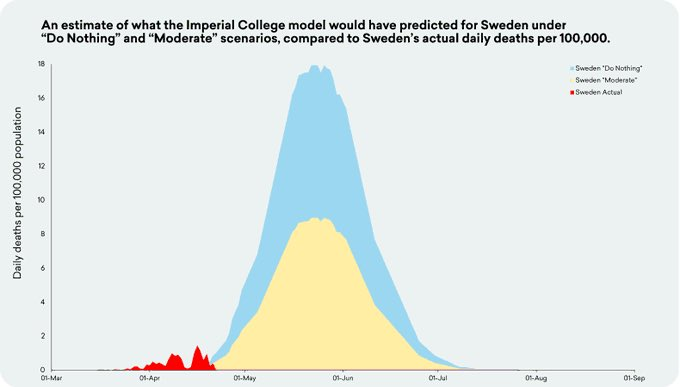
For my elderly readers whose eyesight isn’t what it was, the blue area represents what would have happened under the ‘do nothing’ scenario in Sweden according to Professor Ferguson’s model, the yellow area what would have happed if the Swedish Government had stuck with mitigation – which is what is what it did, obviously – and the red area the actual death toll in Sweden.
We learned yesterday that the response of the Chinese authorities to the outbreak, which the WHO praised so effusively in February, included lying about human-to-human transmission, locking up whistleblowers and refusing to help nations develop a vaccine. Those are among the revelations in a leaked 15-page dossier from the ‘Five Eyes’ intelligence alliance. This dossier is almost certainly what Donald Trump was referring to earlier this week when he said he had evidence that the virus originated in a Chinese virology lab. The dossier says that a team of scientists at the Wuhan Institute of Virology conducted research in into deadly bat-derived coronaviruses, with at least one of the virus samples being a 96% genetic match for SARS-CoV-2.
This will be grist to the mill of Republican critics of the lockdowns imposed in states controlled by Democrats. Which poses the question: to what extent is your reaction to the lockdowns mediated by your political views? The short answer is a great deal, with conservatives being much more likely to oppose extreme social distancing measures than liberals. But why should that be so? The Heterodox Academy has published an article by Luke Conway, a Professor of Psychology at the University of Montana, who has researched that question. Here’s his conclusion:
Conservatives oppose the government telling them when they can or cannot leave their homes; liberals support such policies. Because a threatening disease might validate government interventions that conservatives dislike, conservatives appear motivated to downplay the severity. Or conversely, because a threatening disease might validate government interventions that liberals do like, liberals seem motivated to magnify the threat.
This jibes with an essay by Inaya Folarin Iman published in Spiked yesterday about how the lockdown and the British people’s surprising acquiescence to it has its roots in the “decades-long cultivation of a culture of fear and the sanctification of safety” and “the increasing hyper-regulation of everyday life and the growing normalisation of censorship and suppression of dissent”. Could this be what’s responsible for “coronaphobia”?
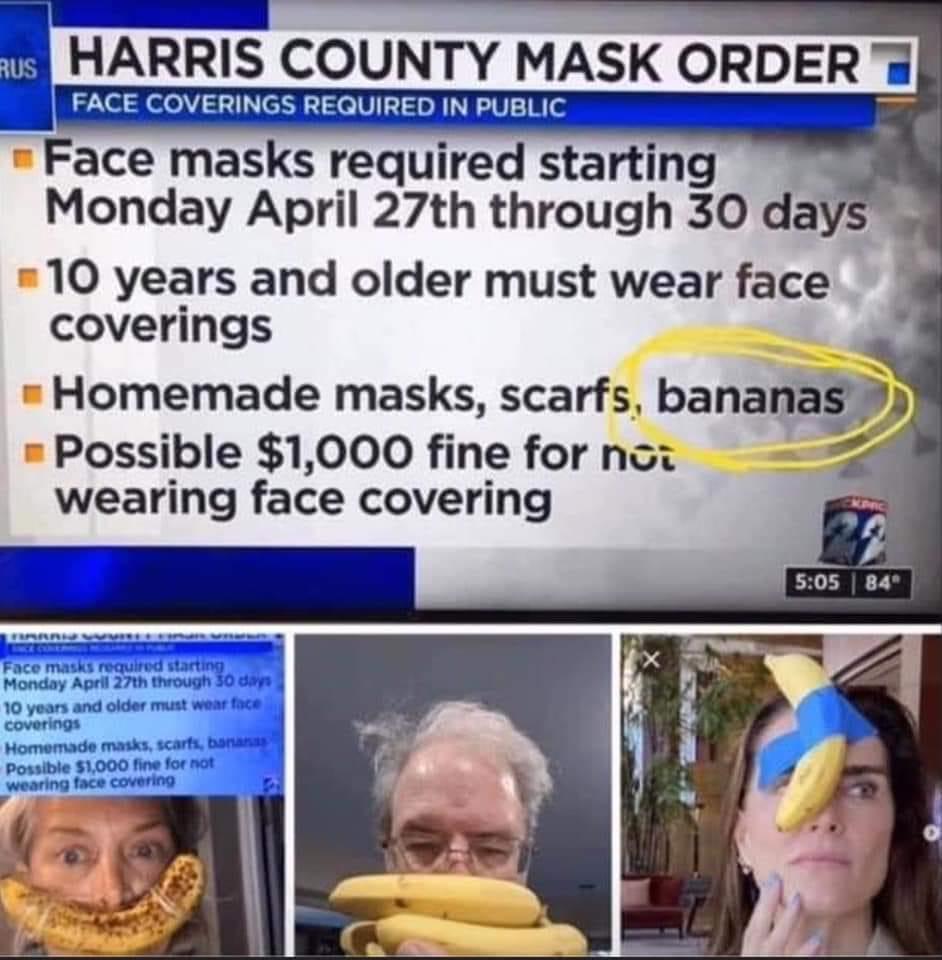
Happily, not everyone around the world has responded so cravenly to being bossed around by the authorities. The residents of Harris County, Texas have been having a laugh at the expense of a recent announcement about what face-coverings they should wear that misspelt “bandana” as “banana”:
Theme tune suggestions from readers are flooding in. The latest batch include ‘I’m Gonna Kill You‘ by Wynn Stewart, ‘I Think I’m Gonna Kill Myself‘ by Buddy Knox and ‘Don’t Fear the Reaper‘ by Ashbury Heights. Keep ’em coming.
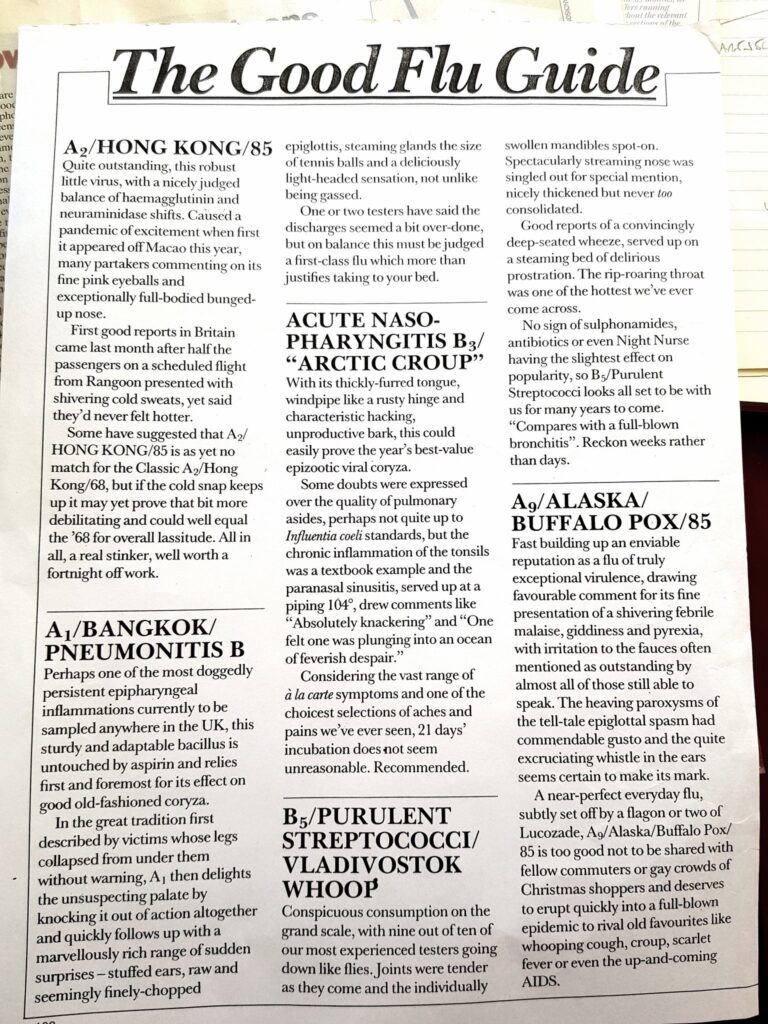
For more light relief, have a read of ‘The Good Flu Guide’, an article published in Punch in 1987 (author unknown). Hat tip to comedian Simon Evans – one of the few right-of-centre comics to appear regularly on Radio 4 – for unearthing this gem:
Thanks as always to those of you who donated to pay for the upkeep of this site yesterday. If you feel like donating, you can do so by clicking here. And if you want to flag up any stories or links I should include in tomorrow’s update, you can email me here. See you tomorrow.




To join in with the discussion please make a donation to The Daily Sceptic.
Profanity and abuse will be removed and may lead to a permanent ban.
More tunes:
https://genius.com/Mose-allison-your-molecular-structure-lyrics
https://www.azlyrics.com/lyrics/red/samedisease.html
https://genius.com/Iron-maiden-virus-lyrics
Some time in the next few days I’ll get round to posting some parody lyrics of popular songs, all now worded to oppose the lockdowns.
Question:
What happens to the tens of thousands of people CANNOT avoid getting “up close and personal” with their customers in order to earn a living? Will they have to wait 18 months-15 years until the vaccine becomes available, before they can get back to work?
I have a vested interest in this because I am a physio in private practice. But let’s just think of the huge numbers of people affected by this problem –
Off the top of my head, here goes:
• Hairdressers & Barbers
• Beauticians
• Opticians & Optometrists
• Doctors (GPs are “phone consulting” at present)
• Dentists (Emergencies only at present)
• Physiotherapists
• Osteopaths
• Chiropractors
• Podiatrists
• Acupuncturists
• Tattooists
• Audiologists
• Sports Massage Therapists
• Nail Salon Workers
• Trichologists
• Tailors
(Who have I missed out on? There must be others!)
Does anyone know how this is to be handled?
Oh, my wife suggested one I hadn’t thought of:
• Prostitutes
(THIS one might directly affect some of our leadership, if past revelations are anything to go by!)
Would lap dancers qualify ?
My sister is a yoga teacher; she’s doing online sessions at present but does have close contact with her clients as a rule, She also does aromatherapy ans fitness training on a one to one basis.
Does farting count as aromatherapy? I’ll need a new direction if BA give me the chop.
Ballroom dance instructor/partners.
Personal trainers
Airport security. There is a silver lining after all…
Prison officers
What many of the fear mongers seem to be forgetting is that social contact IS life. We lose all meaning and joy if we prevent this from happening. The idea that so many people are willing to give up one of the fundamental aspects that makes life worth living, continues to baffle me.
The more I think about this, the crazier it gets. As well as the aforementioned “up close & personal” industries, consider the following: • Pubs • Restaurants • Coffee Shops • Hotels • Theatres • Concert Halls • Night Clubs • Cinemas • Gyms These businesses need a lot of patrons to be viable. If “social distancing” is in place – e.g. “stay 6 feet apart” in a restaurant, theatre, concert hall etc., these industries would be barely surviving at best and more likely, collapsing. So we can add to the growing list of the unemployed, all the staff of the above businesses, all our professional actors, and all our professional musicians (goodbye, symphony orchestras). I reckon 50% of the nation won’t be able to work normally. Cue economic collapse, collapse of the NHS, and other horrors. Solution – find a cure for “coronaphobia” and then all of us bloody we’ll go back to normal work. (While providing protection for the at-risk groups until the virus has burnt through.) We appear to be dealing with a virus at a fatality level of a bad flu – the most figures suggest it has an IFR significantly less than that of the… Read more »
The photos in this article would be funny if they weren’t so tragic:
https://www.thesun.co.uk/news/11468119/europe-adapting-post-coronavirus-lockdown-covid-shields/
For me, the fact that these ‘solutons’ are even being suggested and tested is baffling. No one, surely, would pay money to go somewhere to feel either threatened by, or threatening to, other people..? Be scanned for temperature on the way in? Have to show your current medical status to the waiter? Wear a mask unless in a designated zone – perhaps with a ‘mask hook’ on your table where you can hang your foul, disgusting sanitary pad while you eat?
If they suggest opening restaurants on this basis then the whole concept is dead, if you ask me.
In 1968, did we have a media industry so determined to terrify the bejeesus out of everyone at every available opportunity??
The only light relief at the moment are sites like these, and I have to confess to having tears of laughter run down my face as I read out the description of the A2/HongKong/85 to my OH.
Anyway, when people do start to venture out, it’ll take a week or so to get used to it, but when everyone doesn’t drop dead, things will go back to more normal.
Being human, I suspect we will go back to normal fairly swiftly.
At least, this is my hope!
And for what? It’s just so ridiculous!
Every person that dies is a personal tragedy for someone and is truly awful.
This has to be separated from the politics or every person who dies in future could be the end of civilisation as we all collapse with grief and the fear of upsetting someone.
Totally agree. We are human and need touch. Have had quite bizarre conversations today with people who truly believe that the sky is going to fall. So Chicken Licken.
100% social contact is life. And the long this goes, it’s only going to get worse.
I’ve had three bizarre experiences this week alone.
First, a little girl fell over whilst I was running. Her mum was about 100 yards away. Ordinarily I’d have stopped and helped her to her feet. I did stop but didn’t go near her. It felt wrong.
Today I saw an elderly lady carrying three large shopping bags. I’m sure she lived in the block of flats I was right next to, again, in a normal world you’d ask if she needed a help.
This evening I went to the corner shop for much needed alcohol and did a dance with a guy attempting to go in. I tried to hold the door open for him but could see he was hesitant.
Is this what the ‘new normal’ is? If so, count me out.
I don’t stress about social distancing. I just walk to where I want to get (in a shop/highstreet etc) and some people give me a wide berth whilst others blithely carry on as the ‘old’ normal. I really don’t expect people to stay 2 metres away and have no concerns if they don’t. I suspect many others may feel the same but think they ‘ought’ to stay away. Wish I could work out a signal to let others know I’m not a coronaphobic.
Here’s how hairdressing will be handled : as soon as this ridiculous lockdown is lifted I have agreed with my regular hairdresser that he will be coming round to my house to cut my shaggy mess of hair. Cash in hand. Black economy rules!
When haircuts are outlawed only outlaws get haircuts! You’re lucky- my hairdresser put out a pious finger-wagging Facebook message about “not even asking” her to disobey our governor and make house calls. (I was one who asked). She must fit into Mark’s “martyr” category above.
To add, said hairdresser would have been round weeks ago if it wasn’t for my paranoia about curtain twitching snitches and the fact that the other half is still, sadly, a bit of a sheep regarding this whole fiasco. She does go out to work so explaining a nice neat haircut on her return as ‘oh, did it myself!’ isn’t worth the grief
Lets hope this can make cash-in-hand the new “authentic” thing, so all the pretentious trendy people will start recognising it as the way to go, not only us rational ones.
If I can get hold of my hairdresser, I’ll be doing the same, unless the owner opens his salon. It’s either that or he’ll go bankrupt.
Not to mention close meetings in London flats with supposed IT entrepreneurs.
Psychotherapists & counsellors
Youth workers and youth clubs
Elderly befrienders
Homeless outreach workers
Domestic violence refuges and outreach workers
Drug schemes
Social workers (child protection are currently asking kids to stand on the doorstop and ask if they are OK in front of the neighbours)
It should be through choice:I decide that I would like/need this therapy. It has absolutely nothing to do with anyone else.
For context, I believe that Sweden will do very well without stay-at-home orders. But that graph comparing model vs reality isn’t at their advantage? If anything the graph shows that reality is higher than what the model predicted so far, no? I’m a bit confused as to what it’s supposed to show.
Mid April in red is the same level than May 1st in yellow, so it has grown faster than the model thought it would as far as I can see? But recent data shows a flattening however
It’s not a great graph. They’ve been level for a while – a newer version would be good. Certainly no sign of the exponential rise – if you read off where 2nd May is you’d be about 4/100000; they’ve not risen above 1.5 (on the 4th April). They’re not declining particularly fast, though it’s possible there’s a downwards trend. Certainly not exponential.
Yes, I’m just saying that the graph shows that the real numbers for April are higher than the model predictions… So the graph doesn’t support anything, quite the opposite. It shows that so far, models were too optimistic. I think it will change for May though
The curve of the model was entirely wrong both at the beginning and at the end; it’s not a good predictor of the curve Sweden are following, which rose quicker and leveled off well before the imperial prediction.
Gko, you are right to be dubious, I really don’t know why Toby is still using this plot, as a sceptic I find it embarrassing.
1) the plot needs to have Ferguson’s suppression prediction added to it which included modelling a 70% disruption of commuter movement, as neither of the two lines that have been did.
2) in all likelihood the blue and yellow curves are not in the right place in time, I imagine matching them to reality would require careful r0 measurement in the actual population, something the person who put this plot together would not have bothered to do on Ferguson’s behalf.
3) the reality line includes a deaths plot that is known to contain a false peak.
https://medium.com/pragmapolitic/the-ruse-of-swedish-death-data-bd29a5b9b0ea
We are better than this.
The blue and yellow show a consistent exponential rise – Ferguson’s prediction. The red shows nothing of the sort, whilst the blue and yellow go through the roof towards May the red is going way down. The reality is orders if magnitude better than the predictions.
https://experience.arcgis.com/experience/09f821667ce64bf7be6f9f87457ed9aa
Sweden has one of the best Covid-19 data in the word,updated each day and a downloadable excel file showing each day death,each day ICU admittance.ICU in slow decline but deaths each day clear decline.Naturally they might end up with 4000 or 5000 deaths but not the ridiculous Ferguson inspired figures with 40000 as minimum deaths and 150000 as maximum deaths and that was a conservative estimate according to those Ferguson inspired scientists.
Sweden has seen a 65% reduction in commuter traffic (vs our 80%).
They are in an suppression strategy.
This plot compares a suppression reality to a do-nothing and mitigration (social distancing only) model prediction… which is a little unfair if you think about it.
A little unfair, yes. But I think the overall impression still holds up.
It’s not a suppression strategy, the Swedish government and their medical team regularly talk about herd immunity as a “byproduct” of their policy. My impression, fwiw, is that herd immunity became politically toxic and so a lot of people who are still (rightly) pursuing the herd immunity strategy have had to downplay it or pretend that they aren’t. But the reality remains that herd immunity is the only viable exit route that does not require us to change our society fundamentally and for the long term.
It’s a fair comparison to make because the real difference is between a coercive and a (mostly) voluntary lockdown. The Swedish example proves that coercive lockdown was not necessarily required to avoid the numbers used to justify it.
I saw the establishment’s re-casting of Sweden’s approach as a de facto lockdown before it happened. It was imperative for them that there wasn’t a country without lockdown to compare against. So for a while they tried to pressure Sweden to comply, using scare tactics, apocalyptical model projections and so on. When that didn’t work, they had to re-cast Sweden’s approach as a ‘voluntary lockdown’. Job done. There is now no relevant ‘control’ to compare against.
Job done only if we let them get away with it. “Voluntary” lockdown (Swedish style) is fundamentally different from coercive lockdown (UK etc style), and that’s the real point.
It is a suppression strategy, by the very definition they have asked people to work from home, and 65% of people in Sweden have complied. This has limited their freedoms. By definition, mitigation, is not about doing that. It is about washing hands and only the sick staying home. If you’re going to build a plot to compare things, and bash someone’s name as a consequence at least be comparing apples with apples. His line was a mitigation line, not a suppression line, so a data “misquote”. We are all reaching herd immunity, that argument is flawed. A transmission dynamic suppressed population will have a lower herd immunity ceiling. It will burn out, just like people think it would have done without any measures. BUT, unless you get cases to 0 before you lift any measures (which will take months), all it means when you lift the measure is a second peak, as the true and higher underlying herd immunity ceiling re-emerges. The answer no one has is which one caused it, and no argument I’ve seen disproves either as a possibility… so the question really is to Boris “Do you feel lucky, well do you punk?”. … and you… Read more »
No, you are focusing on overly narrow technical definitions, rather than addressing reality. It’s not helped by the prevailing tendency towards “political correctness” in evading the issue of herd immunity. The real issues are whether you are taking all possibly steps to reduce the spread, and whether and to what degree those steps include coercion.
As Johan Giesecke observed recently: “Lockdown moves dead people into the future”.
“… and you can’t make that decision in his shoes, he has to show prudence.”
Rather absurd to claim that it was “prudent” to take drastically damaging steps with unknown but open ended consequences. The plausible downside “worst case” for the kind of profound economic damage inflicted by coercive lockdown would be systemic collapses of various kinds, which is effectively an open ended situation, involving wars, revolutions, famines, etc. On the other hand, the plausible “worst case” for a disease like this one would be a percentage increase in the annual death rate.
It’s quite apparent that the government acted in panic, and as is usual with panic responses, it was the absolute opposite of prudent.
Address this reality… … I’ve never heard such guff. I think both suppression strategies are blunt instruments that will lead to many deaths, they already estimate in the UK 18k cancer deaths alone… https://scienceblog.cancerresearchuk.org/2020/03/19/coronavirus-and-cancer-latest-updates/ … but, how many more are going to happen in Sweden too? I don’t have any “political correctness” issues with herd immunity. BUT, I do have a problem with denying: – people treatment in the short term along the way because you’re crap at sums, – or, that both countries are stretching their health services to the limit. The level of suppression needed boils down to one simple question. Do you think the UK and Sweden had the same rate of new case growth ahead of any measures? … if you can show me this was the same, then I’m perfectly happy to agree the same measures would have worked. Trouble is when you actually look at the data (above), it doesn’t stack up. New cases per capita were growing in the UK at about 2x the rate in Sweden (there was very little change in testing rate in both over this period so this doesn’t explain it). Yet, their measures have not quite stopped new… Read more »
Why would I bother trying to “address reality” with someone who opens his post with the old propagandist’s trick of posting a closeup snippet of a graph out of context and without the zero point? It’s pretty clear we are on very different pages here anyway, with you clearly fully bought into the nonsense idea of this disease as fantastically dangerous. I take the view that the numbers show it really isn’t a big deal from a national overview perspective, unless obviously we choose to make it so by our response (which is what we have done, evidently with your approval though you disagree on a few minor details). A few hundred thousand deaths mostly of people who were going to die this year anyway simply is not a cause for panic response. I’ll leave it with the apt words of a Nobel prize winning chemist and Stanford Professor of Structural Biology who has been studying the numbers for this disease since January, quoted on this very site: “I think the policy of herd immunity is the right policy. I think Britain was on exactly the right track before they were fed wrong numbers. And they made a huge mistake.… Read more »
Anything Ferguson-inspired is going to be way over the top by at least a rough factor of 20 times. Have you SEEN his past history of spectacular fails?!
Why anyone listens to him I have no idea. Old Boys club I assume.
I commend someone to write a book about this lockdown period. Personally, as both a sociologist and businessman, it has unquestionably been the most interesting socio-economic and scientific event of my life. There would be so many captivating themes to cover from ‘herd behaviour’ to ‘moral panics’ and good old! proportionality and risk management, etc.
As data analysis of this event should be clearer by them, I also commend publishing the book for xmas when the wider public (at least a larger minority) will be ready for an alternative perspective on what has passed. It will also provide excellent competition of what will surely be a celebrity chef book with the title’ ‘cooking for the mass unemployed or those who have suffered a sudden and significant drop in income (tax). Not catchy, but you know what I mean…
That made me properly LOL (the book title). I agree, we do need that, it’s been fascinating and maddening to watch.
Chapter one would start no doubt in Wuhan , whether in some wet market or laboratory is still to be decided. Chapter two would of course be elbow bumps ( remember those) and toliet paper. Suitable title ” the World goes Mad ” .
Has anyone found a graph of the COVID trajectory that starts in December, or whenever the first cases are now thought to have appeared? And that accounts for the hundreds of thousands of cases that seroprevalence studies suggest have already occurred? It would be interesting to see when the actual peak occurred by that measure, and how high it was.
Isn’t it possible that all the curves we’re looking at are in fact just a chunk of the right-hand side of a much bigger curve? Our curves that begin when testing started could show a rise that initially looks exponential, but that’s just until tested cases hit the bigger curve, and then the “peaks” appear to be peaks simply because tests have reached number of bad cases. The falling numbers are due partly to the fact that the epidemic is naturally petering out anyway.
I would love to see this modeled by someone with the statistical chops to do it.
I think I already replied to this on a different post so maybe you were hoping for a better answer from someone else 🙂 The Gupta paper is better than my noddy model: https://www.medrxiv.org/content/10.1101/2020.03.24.20042291v1 If you look at Figure 3, it shows various scenarios compatible with the observed deaths in the UK. The point they’re making is exactly what you’re saying: that you don’t know if it started earlier and was less fatal or later and was more fatal. That “rho” value (Greek letter that looks like a p) is the proportion of the population at risk of severe disease. For “theta” (the proportion of those guys who die) they’re using 0.14. The lowest rho they run with is 0.001, which, multiplying by theta, would be an IFR of about 0.014%. On that assumption you’re a bit further than half-way through the epidemic by the time you have 100 deaths, and it started in late Jan. They’re using yellow for this scenario on that chart. They’re not saying they think the severity of the disease is that low, they’re just exploring what things would look like for a range of severities. Now it could have started even earlier and be… Read more »
Oh, no, I missed it! Thanks!
Right at the start of the lockdown, March 24th, I started to compile a list of “classes” we’d experience. 6 weeks later, I’m still adding to it. Feel free to reply with your observations of the different lockdown classes. The Snitch Class: Will happily phone the new government hotline to report you for leaving the house. They’re also keen for the proposed new changes to the Mental Health Act to come into play so that you’ll get locked up on the advice of one doctor. The Martyr Class: They know they’re not breaking the rules by going to work, but they’re happy to let their business – and finances – die. And they’ll let everyone know about it while looking down their nose at those who are determined to push through and keep their business going. The Scrounger Class: The ever-present among us. They’re delighted that new benefits and easier credit will be coming to them. And they handily develop a “dry cough” when it’s time for their visit to the Job Centre. The Flagellation Class: Nothing makes them happier than more pain and discomfort. They’re usually seen on social media posts screaming for the government to do more to… Read more »
Shocking statistic of the day – a YouGov poll shows 28% don’t want the lockdown restrictions lifted.
Co-incidentally ONS data shows 27% of the workforce were furloughed between March 23rd and April 5th.
I guess the additional ~1% are the 500000 teachers ?
Lol. It’s gonna be amazing to see everybody’s attitudes flip once their furlough ends.
And, let’s be real, once furlough ends everyone is getting fired. Wonder how much they’ll love the lockdown then.
I wrote a lengthy post on Facebook a couple of weeks ago that referred to the “stay at home, it’s not hard” crowd, many of whom are not even considering that the jobs they’ve been furloughed from won’t be there when this is over. But never, mind, pour another gin, Tiger King is starting.
Would this be the 2;% who believe in global climate catastrophe change, and vote for Corbyn by any chance, or am I being mean??
The Feisty Rebel Class – albeit a very small minority who aren’t panicking, keep sneaking out under the radar and have no intention of acquiescing to mandatory vaccines or downloading the NHS contact tracing app.
…Or wearing a bloody facemask unless physically forced to do so
As a Guardian reading, left leaning sceptic who fiercely opposes the lockdown and has said from the start that tbe mitigation measures will be worse than the virus itself, I do wish we could get away from the left/right political points and snide digs. Any of us with common sense and an awareness of history know that the lockdown is a hysterical response and led by pseudo scientific modelling. You don’t need to be right of centre to know this. But I certainly do recognise a lot of your “classes”!
Oh, hello!!
Another Guardian reading left leaning sceptic!! You are right that ‘you dont need to be right of centre to know that the lockdown is a hysterical response…’
But there seem to be so few of us.
The reality is that this does seem to be a strongly left/right biased issue. The study mentioned in the editorial above argues that this is probably to do with attitudes towards the state policies and moral attitudes that this fear-based crisis attitude mandates, and that chimes with my own experience. Those on the left tend to like the agendas promoted by pretending this disease is as infectious as flu and as dangerous as ebola – massive state spending, worship of collective health provision, suppression of individuality and dissent (as with “hate speech”). I guess the exception that might include you would be the libertarian minority on the left. I would suggest that this crisis is probably illustrating just how small that libertarian minority actually is on the left. The left likes to talk a lot about being liberal, but when it comes down to it they love collective authority and suppressing dissent as “hate speech” etc. Admittedly, it’s also the case that by no means all on the right are opposing the lockdown either, indeed in this country the “establishment” right is mostly fully on board with it. Though that merely confirms my own assessment that the establishment right is… Read more »
Hector Drummond’s analysis is flawed by not adjusting for age. The ratio of male:female deaths is ‘normal’ times is not constant by age group but in the ratio, crudely, of 60M:40F in under 75s and reverses to 40M:60F in the over 85s. Obviously overall it is around 50:50 as in the long run, as Keynes observed, we are all dead. The impact of this is that the largest ‘excess’ deaths occur in the most elderly (2,500 more than expected) where we would expect more women than men to die. Note the ratio of females to males in care homes is 2.5:1
And to add, analysis of ONS data for deaths in care homes shows the ‘excess’ increasing week on week, with the increase in diagnosed COVID cases. If the excess was non-covid related i’d expect more of a flat line from the point of lockdown, certainly for acute MIs, strokes etc.
Obviously, a major concern is for more chronic conditions and oncology, and it is paramount that normal service is resumed as soon as possible, employing some some of the gusto and can-do spirit
that was evident in the creation of the Nightingales.
The Nightingales that were so quickly put together by our Armed Forces…
Yes, exceptional article in SPIKED. The most articulate commentary I have read on the virus / lockdown in the last 6 week. This article should be posted to the nation!
https://www.spiked-online.com/2020/05/01/our-culture-of-fear-has-driven-us-to-irrationality/
Economist Mike Schussler wrote: The past 5 weeks 86 people allegedly died in South Africa of Covid 19. Meanwhile the country’s economy lost R500 billion. Each death cost the country R5.8 billion. Are we using cannons to hunt mosquitoes? For the people crying for the country to remain shut down, answer these questions: 1) How many children should starve in order to make you feel safe? 2) How many families must go bankrupt in order to make you feel safe? 3) How many wives and children must be stuck at home with an abusive husband/father in order to make you feel safe? 4) How many business owners should lose everything they’ve worked for in order to make you feel safe? 5) How many people are you comfortable with committing suicide from hopelessness and financial ruin in order to make you feel safe? Come up with an actual number, don’t just dismiss the questions. Come up with the number of people that you think should surrender their lives for YOUR feelings and YOUR safety. Does it make you feel safer knowing that your unwarranted fear and panic are costing others their livelihoods and even their very lives? Each time you whine… Read more »
THIS. I saw someone I know on twitter today doing emoshuns about her father in law who died ‘of the corona’. (He was 85 and lived in a care home and had liver failure or something). He WENT OUTSIDE ONCE to get a hospital check up (where, I’ll concede, he probably caught it) and DIED. He’s the only person I know (of) so far irl who’s had the corona with a terrible outcome.
But. Quite frankly. He was dying anyway. I actually know one person who has killed herself in the past fortnight at the age of 35, and probably wouldnt have done if not for the lockdown. Now, honestly, which is worse? Are the ‘representative’ (old, already ill etc.) Corona deaths, even if there are more of them (and I’d wager there won’t be anyway) ‘worth’ more to society than young people’s? Is it worth saving 20,000 lives if you ruin 20 million?
Absolutely! I’ve flagged up the 1968 Hong Kong flu several times as an example. 80,000 dead in the UK and you barely knew it was happening. No panic, no hysteria, no lockdown. Oh, and no Bill Gates vaccine. It burnt itself out and the herd developed natural immunity.
I, too, have referred to the Hong Kong Flu from 1968 to 1970 on other websites. As you say, we knew nothing about it at the time and even if we had, it would have just been considered a part of life and death. It certainly never made the front pages of ‘The Daily Express’ or ‘The News of the World’, for instance. Wikipedia for 1968/69/70 similarly makes no reference to it, the only detailed information I have come across being in epidemiological papers on past pandemics.
The contrast between what did ‘not’ happen with HK Flu and the current hysterical response to Covid19, a disease probably no more dangerous in terms of its fatality, is staggering.
Unfortunately getting out of this mess is no longer about adopting sensible policies based on reliable up-to-date data. Instead, it is morphing daily into a face-saving exercise in political chicanery.
For those who haven’t seen it:
https://www.google.com/amp/s/www.craigmurray.org.uk/archives/2020/03/momento-mori-unpopular-thoughts-on-corona-virus/amp/
(Note the estimated 80,000 UK deaths is from “UK Govt. sources” in case the buggers try to change the stats later on!)
So true – if I may I will plaigarise those questions and use them myself to address the masses cowering away here in the UK.
Wouldn’t it be just sublime to have a decent investigative journalist sticking these to Matt Hancock and not letting him get away with the smug corporate style “Thanks for that great question” and then try to deliver his script.
If only….
Dennis Prager: “Safe means never.”
This was in reference to a number of people he knows who have said that they’d love to visit Israel, but wouldn’t until it was “safe.”
To which he says, that means they’ll never go.
Nothing is safe 100%. Nearly everything is a risk, e.g. just driving to work, or to go shopping. Life isn’t safe, but you can’t stay hiding in your home, in bubble wrap, forever.
Testing testing 123
Had a quick look through the WHO report mentioned in your article, Toby. Section 6.1 is about contact tracing. OK, it’s Flu not Covid but the report uses an Ro of 1.8, Covid is thought to be higher at 2.6ish. The report talks of a “presumed high level of pre-symptomatic or asymptomatic transmission”, again Covid has a very high asymptomatic transmission. The WHO recommendation:
“Active contact tracing is not recommended in general because there is no obvious rationale for it in most Member States. This intervention could be considered in some locations and circumstances to collect information on the characteristics of the disease and to identify cases, or to delay widespread transmission in the very early stages of a pandemic in isolated communities.”
The Ipsos Mori poll should have distinguished between people who are regular users of social media and those who aren’t. The former seem to be the people most afflicted with severe “coronaphobia” and want lockdown to continue until a vaccine is found, or forever for some it seems, so terrified they are of the outside world, where death from CV19 stalks them at every tin of beans or door handle. Instead of going out they sit at home and scroll through Facebook for 18 hours a day, looking for all the scare stories to bolster their fears. I haven’t left my house for seven weeks because going outside is like playing Russian roulette one said and if we want to get out of this thing alive we have to stay at home, despite there only being 0.06 deaths per 100 people in her county. The fact that’s she’s far more likely to be killed in a RTA doesn’t register. Lockdown is essential to reduce risk of dying, they argue. One death is too many. So why aren’t those people insisting – once this pandemic is over – that speed limits on all our roads, including motorways, are reduced to 20… Read more »
I meant to add, as a positive aside, that my partner’s 84 year old mother, has turned into something of a lockdown rebel. Not only does she go to Sainsburys every day, even when she doesn’t need to buy anything, but she, and many of her fellow residents at her assisted housing accommodation, have rebelled against ‘the management’ who initially tried to close the communal gardens. They staged a revolt, took back the gardens and, despite management attempts to restrict visits to only one person at a time, the gardens have been fully liberated and are now enjoyed again by all those who value freedom and fresh air to being imprisoned in their apartments in their twilight years.
I love this. UP THE GREY REBELS!
This story gladdens my heart! Similar to what I’ve seen locally, the Sainsbury’s here has been allowing the grey brigade to gather in what was the café where they can be ‘kept an eye on’ in the words of the manager..
We have 3 neighbours in their nineties. One has said she’s fed up of this silly fuss and being treated in such a condescending manner by government. At 90 I’m on borrowed time anyway so I’m not wasting it, she says! Atta girl!
https://www.spectator.co.uk/article/lancet-editor-s-chinese-propaganda
Worth reading
https://www.timesofisrael.com/what-does-survival-of-the-fittest-mean-in-the-coronavirus-pandemic/
Another very good article
Yes, excellent article and it discusses another “elephant in the room”. We have been brainwashed over decades by the pharmaceutical industry, to give away control of our health to this industry with the underlying notion that we all are weak and helpless against disease, and must rely on the patented products of giant corporations to save us.
Drugs and vaccines do have their place but we are also individually responsible for our own health. In viral pandemics there is the need for us to have (1) an immune system robust enough to deactivate the microbe, BUT also (2) an immune system that does not over-react to the microbe – this is the “cytokine storm” which is the cause of most deaths with this pandemic.
The immune system is much more likely to over-react if the person is already in a state of systemic low-grade inflammation, and this is seen most often in obesity and metabolic syndrome – which means that our diet and lifestyles are REALLY important!
If nothing else, this information needs to get out there so that people can give themselves the maximum chance of surviving whatever pandemic we are blessed with next time.
An anecdote from the early years of my practice to illustrate the above. A 25 year old lad came to see me because of “joint pain”. When I quizzed him he had pain in virtually ALL his joints. He was 25 going on 90. Fortunately, he’d already had a full medical work-up so I knew what was NOT wrong with him. He’d seen the GP who did some basic blood work; all normal. Referred to a rheumatologist. Loads of additional, sophisticated blood work done; all normal. Thence to an orthopod. X-rays and scans done; all normal. Back to the GP. “We can’t find anything that explains your symptoms – you’ll have to learn to live with it.” My first question to this lad: “TELL ME WHAT YOU EAT AND DRINK EVERY DAY.” Answer: • Chips • Crisps • Pot Noodles • Pizza • Beer • Coca Cola My second question: “Do you smoke?” (Each cigarette deactivates around 25mg of Vitamin C). Answer: “Yes, about 30 a day”. The guy was suffering from MALNUTRITION! In a fairly affluent part of the country! Now, if that was today and he’d contracted Covid19, the nicotine might have had a slight antiviral effect but… Read more »
Until recently I thought the biggest government ‘faux pas’/cover up of recent years was the invasion of Iraq….
Until recently I thought comparisons of Boris to Churchill had some foundation…
I’m now thinking… Chamberlain, September 1938!
Please (if you haven’t already) all sign up to Simon Dolan’s action. It’s all we have
How do we explain that cases are increasing in line with more testing in the US while at the same time ICU admissions, hospitalizations and also deaths of Covid-19 are dropping? They are finding an enormous number of asymptomatic carriers. What is the poor governor of Tennessee going to do when he finds on his desk a report of more than 1000 cases of Covid-19 in one day in his state while the few deaths and few hospitalizations of Covid-19 are declining? More of the lockdown? He then realizes that those reportable PCR positive Covid-19 cases are all from prisons where they have tested 2450 persons staff and prisoners and 1200 were positive and 98% of them were asymptomatic. https://www.wmcactionnews5.com/2020/05/01/tenn-covid-unified-command-group-launches-mass-testing-plan-state-prisons/ The UK is going to have an expanded testing guiding us from the lockdown. What are we going to do if we find massive increase of asymptomatic cases (heaven forbid if they start mass testing all our prisoners)? Continue with the lockdown? Let us accept the defeat. There is no way we can outsmart this virus which is extremely contagious and infects asymptomatically most people and a few get sometimes a very nasty disease. You cannot control this infection in… Read more »
“Conservatives oppose the government telling them when they can or cannot leave their homes; liberals support such policies”
I for one have always considered myself a liberal because I believe in the principle of everyone having a right to do whatever they will provided it doesn’t measurably harm others, hence as a liberal I’ve always been in opposition to bossy governments. I think the author of that article might want to be a bit more careful in how he tries to define people, anyone who is genuinely liberal opposes state interference in the private affairs of human beings.
I think his use of the term liberal is more in line with the American demographic of “liberal” who are typically very left-wing, and as a result, socialist…and by extension enjoy a big state that controls every aspect of life.
I’ve noticed on Twitter that the biggest fans of the lockdown, calling for it to be extended and tighter, are lefties. But, socialists like a high-control government and a healthy death toll…
I disagree. From my occasional twitter checking, I’d say the opposite is true and there is a very pro Tory, pro Brexit majority who are determined to outdo everyone else in their lock down martyrdom. But I really want to get away from the left /right split on this. Anyone concerned about freedom, the economy, mental health, a properly resourced NHS that can cope with spikes in viruses, not to mention Government reliance on a very suspect scientist, should want to end the lockdown.
I’d noticed that! One hypothesis I’ve come up with is there is a degree of hero-worship of Boris on the part of *some* Brexiteers* – they will probably follow his lead in things although how the ‘had enough of experts’ line of thought jibes with following Ferguson is anyone’s guess. This is possibly tinged with the isolationist views some Brexiteers have. I’ve noticed most of the serious Brexit commentators on Twitter tend towards scepticism.
*I do not wish to insult Brexit supporters, I understand both sides of this argument!!
I think we’re unlikely to be helped out much by the virus evolving not to kill its hosts. If you get COVID-19 you are either immune after a week or two or dead after three. Both scenarios are equally bad for the virus’s “survival”, although if you die you may actually be infectious for a bit longer.
Coronaviruses in general, including this one, will have evolved over millions of years not to be excessively fatal, which probably helps a bit, but obviously has nothing to do with lockdown.
It may well be true though that there are a lot of nosocomial infections and that if we had let the less vulnerable part of the population build immunity rapidly the overall outcome would have been better as the whole epidemic would be over sooner. But you do have to balance that against overwhelming the health service.
You have hit the nail on the head with your final comment. The reality is that, despite all the emergency plans in place, the NHS cannot cope with spikes in demand. This isn’t a criticism of NHS front line staff, but is very much a criticism of a government that has systematically starved the NHS of funds. The result is that everyone has to suffer, the country is bankrupted, lives are ruined, NHS staff die, cancer diagnoses plummet as all attention is on trying to stop a few deaths of people who would have died anyway from something else. Even adding together deaths in care homes, I calculate that 99.94% of the UK population haven’t died of Covid 19. We need a proper plan for dealing with these recurring events. Which means not creating panic, misery and economic ruin through an absurd, unnecessary lockdown led by bad science.
I disagree with this, though I agree with your overall view of the panic. It’s not rational, nor is it morally better, to spend lots of money maintaining surge capabilities that really aren’t needed, and I don’t see an NHS that has had fantastically expanding budgets over the decades it has been in place (mostly to deal with the expansion of collective healthcare to deal with things it was never originally intended to deal with, and with ever-extending life expectancy) as being remotely “starved”. It should be the case that when a rare emergency situation comes along (a few times a century) we require emergency measures to expand the health service capacity to deal with it, and that should cost a few lives. If not, then we have been spending too much on it at the expense of other priorities. Prolonging every life at any expense is not a rational or a moral approach to policy. If we had responded rationally to this emergency we would have addressed it as a medical emergency rather than turning it into a medical emergency combined with an economic crisis and a socio-political catastrophe , as we have done. Some people would have died… Read more »
We need to open up and forget about this. I’m sick to death of all the fear and loathing. Life is risky and all the better for it.
If we hadn’t known about this virus, would any of us noticed anything was amiss by now? Would it have even made the news? No, it wouldn’t, which probably says something about the respect we have for our elderly as a nation (which is why the hypocrisy is driving me mad now) but I agree it’s a non-event, and we just need to admit we made a mistake, do right by our oldies, and forget about it.
Scrapping the “2 metre rule” seems a bit dumb. Might be wiser to adjust it to “keep 2 metres, or further if possible, from others whenever you can, but accept that this rule will inevitably break whenever a large number of people need to get into a space”. Leave the markings on the floor, encourage not brushing right past each other in the street, but let as many people as necessary into a shop so as to avoid queues. Encourage people to travel, especially for public transport, at off peak hours, stagger work shifts to remove rush hours, have shops open earlier and later so people can go when they are more likely to be deserted, but recognise that sometiems crowds will form regardles. These are things we should have been doing from the start, and need to be doing now, rather than the oppressive lockdowns.
No, the two metre rule is unsupported medically, and contributes to the problem rather than giving any significant benefit, because the real problem is the endemic fear, not the really not particularly dangerous virus. How many infection spreads will have been prevented by people staying 2m apart while outdoors? Virtually zero. How many deaths? Probably actually zero or thereabouts. How many people made ill by being discouraged from going outdoors to “prevent crowding”, or injured stepping into traffic to avoid getting within 2 metres of another pedestrian (I’ve seen people step into roads quite frequently like this – if they are doing that then a small number of cases will do it when it’s dangerous), and how may confrontations over people “getting too close” have resulted in assaults and injuries (again, this happens and has been reported)? Probably not many, but probably quite a lot more than zero. But it’s the fear engendered by this stupid, paranoiac over-cautiousness that is the real harm done. From yesterday’s Telegraph: “Prof Robert Dingwall, who sits on the Government’s scientific advisory body New and Emerging Respiratory Virus Threats Advisory Group, which feeds into Sage, said it “made sense” to reduce the distancing rule to… Read more »
Toby, you can’t quote evidence of mass reduction in commuter traffic as evidence social distancing worked. This is a lockdown measure, voluntary or not, Sweden has seen similar 65% reductions in movement. This is a loss of liberty in both countries, to call is social distancing is disingenuous. More so, to assume that both countries needed to same reductions is naive. As this plot of new case growth against commuter reduction shows, Sweden has only just managed to possibly curtail new case growth, but has only voluntarily managed less commuter reduction… BUT, given the gradient difference before we stood no chance, we had much faster growth. So I find it hard to believe the argument the government could have asked us to do less like Sweden could given being less dense. One size does not fit all… https://medium.com/pragmapolitic/is-a-lockdown-digital-or-analogue-ead71e6fdd18 The real question is to what end is a government asking us to do this? Both countries will end up at a suppressed herd immunity ceiling that will only rise if we all start moving around more again. Surely this is about both governments following the Chinese/South Korean super contact tracing models so that they can target quarantine to far fewer of… Read more »
I don’t think it really is about trying to do track and trace (what’s the third T a tyop?) but they’re sort of half-pretending it is because they don’t want anyone to figure out that the gameplan is the unpopular but inevitable herd immunity.
You’re right that if it really was TT they’d need to be properly on top of it. More likely we will have a buggy app 18 months too late costing millions that nobody will install anyway.
For that strategy to work you’d also need a very effective lockdown. I don’t think ours was (fortunately). We’re probably pretty close to herd immunity of a sort and basically we need to find an equilibrium with sustainable recommendations about hand washing etc. Sweden is in the same boat.
Singapore seem to be aiming to go back to TT which worked quite well for them at the start, after a strict lockdown. It also worked in Iceland. So it is possible but too late for that in the UK and we wouldn’t get much benefit from it at this point.
Test, Track & Trace…
You can’t get to real herd immunity with a suppression strategy. You get to a lower herd immunity (15% not 65%) for the rate of spread in lockdown. You’d have to hold the lockdown in place for ever. This can’t be their strategy.
Which is what I’m against.
It is possible as the S. Koreans have shown to have as much if not more freedom than Sweden and to eradicate the virus. This is the strategy the governement seem to be on. Bear in mind our population density, save and demographic is much more like South Korea than Sweden. So they are a much better comparison of what we could be doing.
You don’t need a country wide lockdown strategy for TTT. You just need to find a keep a very small number of people in lockdown (quarantine) with 99.9% of the population free to go back to work.
You do need to get case numbers lower, the lockdown is lowing case numbers fast, I’d say in a 2 weeks we might be low enough to start trying to do it.
Yes you get to a lower herd immunity but if the measures are sustainable you might be able to keep them in place until you have a vaccine. In other words not a lockdown but people keep washing their hands and being careful, that sort of stuff (which may well be just as effective as lockdown anyway). The more immunity you have the easier this is– any handwashing etc. gets added to the effect of partial immunity. This seems like a plausible strategy for the UK and Sweden. If our case numbers get low enough in 2 weeks to do TTT is that because of lockdown or is because of herd immunity? If the latter then there’s no point. I suspect it is the latter because based on the number of people already dead in the UK and reasonable estimates of the IFR we should be close to if not at herd immunity already. In other words the epidemic has basically pretty much run its course irrespective of the measures, which were too late and too permeable (people were still travelling on the tube) to make much difference. Also note that once herd immunity gets underway it grows nearly exponentially,… Read more »
Sweden has 65% of people working from home. This is not just hand washing. I don’t think either what they have or what we have is sustainable for 2 months, never mind a year. It is the suppression measures that we have in place that are leading to the drop in cases, we have inhibited the transmission dynamics enough to mean at this level of spread (we are at about 12%) there are enough immune people to see cases fall. If we get them to fall enough we can start contact tracing again. I’ve been want to spend some time finding South Korean data on the size and sustaintability of their TTT model. We need to start forming an idea of how low case numbers would need to be in the UK for this to start. Without getting this clear, being able to hold Bojo to account over this is hard. You are not understanding herd immunity with what you say. It is not a fixed thing, it is a function of the current transmission dynamics. By that I mean with the measures we have are artificially holding the herd immunity ceiling at about 15-20%. If we lift measures the… Read more »
My assumption about herd immunity is that you need 1-1/R0 of the population to be immune to have R at less than 1. If R0 is 2, you need about 50% your population immune to kill the epidemic. If R0 is only 1.5 then you only need 33%. There will be a few other effects like overshoot– if you let the epidemic run too quickly you may end up with more that 1-1/R0 infected. But I’m ignoring those for now. Now suppose in a given society behaving normally, R0=2. You then got it down to < 1 by imposing multiple restrictions whose combined effect was to subtract 1 from R. So it goes from 2 to 1 and the epidemic starts to die out. Great. If you now lift them then R goes back to 2 and you wind up with the same 50% infected and 50% * IFR dead people as you would have anyway, plus a bunch more unemployed people. Not so great. But suppose that by the time you imposed the restrictions you already had 33% immune. This means that R was 1.5 at the time you imposed them. You therefore reduced it to 0.5 with the… Read more »
The lockdown announcement maybe increase compliance from about 65% to 80%, it pushed the measures a little bit further. Commuter data shows that the suppression measure of asking people to work from home was pretty much voluntarily taken up by most people starting weeks before the official date. Toby’s entire argument is it didn’t need to be enforced as people were mostly doing it anyway, like in Sweden. My issue with that is that new case rates were growing far faster in the UK ahead of any measures, and given Sweden’s rate of new cases is still growing, I just don’t think we would have turned the tide, and we need to in order to have a stab at making TTT work. As South Korea’s advice is, get cases as low as possible if you want to stand a chance of getting them under control. You provide no evidence that lifting these transmission suppressing measures will not raise r0, and sadly I think (to be fair researchers) they do have a reasonable idea of which measures are having the most effect, with working from home is the biggest one. All the serology studies calculate the CFR, and importantly the death/1m… Read more »
So did the Gangelt study indicate an IFR of 0.37%? This is often quoted but my reading of the press release was that IFR was 0.15% and CFR 0.37%. Extrapolating their numbers to the whole of Heinsberg gave me 0.12% so 0.15% seemed about right. Santa Clara, another study in California, and recently one in Iran all put the IFR at about 0.15%. This is also consistent with Iceland were 0.7% is a strict upper bound (that was their deaths over actual positive tests last time I checked, and their epidemic is kind of over so you don’t need big time adjustments). But of course they haven’t tested everyone. If you assume their testing is random (but it won’t be) you get an IFR of less than 0.1%. So an actual IFR in most places with an average age of about 36 or so is probably around 0.1% to 0.2%. In NYC it is at least twice that. Whether this is due to the way they count deaths or to their health care system being overwhelmed or both plus other factors is not clear. IFRs of closer to 1% are not believable unless you think Spain, Italy, the UK and… Read more »
Excuse my loose reference, the CEBM has the IFR (not CFR so including asymptomatic cases which is what I meant) of 0.37% for Gangelt which is what I meant… https://www.cebm.net/covid-19/global-covid-19-case-fatality-rates/ You can’t do the “extending to the whole of Heinsberg” thing you are doing. You’re implicitly making a whole load of assumptions about the rest being uninfectable that you just can’t do?! As to Santa Clara, I looked at the study in detail. They estimated deaths, and they conceded their serology sample group contained younger more mobile people and that were likely to have seen more spread in their sample group, but then made no account in adjusting for the death demographics, so the IFR is probably and underestimate as their denominator is likey too big for the age in the numerator. So I tend to ignore it as an outlier… figures that seem way less bias to me are: – Gangelt 0.37% IFR – NY 0.6% IFR https://www.washingtonexaminer.com/news/stunningly-high-reported-new-york-infection-rate-illustrates-coronavirus-uncertainty – Robbio 0.7% IFR https://www.unz.com/isteve/even-a-town-in-northern-italy-is-still-pretty-far-from-herd-immunity/ … all IFRs so including asymptomatic, so I work to an average of 0.5%. I don’t see the argument for any of the adjustments you are making. Iceland has not done a serology survey. PCR results… Read more »
OK. I would estimate IFR to be between 0.1% and 0.5%, more likely to be at the lower end of that scale. Not far off but we’re getting into a grey area here.
I think we both agree lockdowns suck. The question is then which is a better strategy for the UK at this point? TTT or herd immunity (with sustainable distancing guidelines to lower the threshold)?
IFR between 0.1% and 1% corresponds to immunity levels in the UK between 50% and 5% respectively. If we’re at 50% then herd immunity is the better strategy. If we’re at 5%, TTT (I already conceded that).
So what about 0.5%? Difficult call. I don’t know where exactly I would draw the line between these two strategies.
The problem with an IFR of 0.5% and a natrual infection ceiling of 65% is you talking about 215k deaths to get to herd immunity. With proper treatment for all which is starting to sound like Ferguson’s numbers…
… we either need to find proof that these numbers are CFR not IFR (so don’t really include all asymptomatic cases because the don’t all develop antibodies), and suddenly find we are much closer to herd immunity and we can just lift all the measures.
OR
I they are really IFRs and we think we are only 1/5 of the way to actual herd immunity we need to crack on with TTT asap. Squash cases fast and then switch from quarantining the whole country to just doing the very small subset that are in the contact tracing networks for confirmed cases – like the South Korea’s seem to be doing.
I agree the latter will be really hard to crack… but, if we can it is a great model for all future pandemics.
Of course antigen tests are not the same as antibody tests. But they are still data and they can be used to estimate IFR, but not in the same way. Go and look at covid.is/data for yourself and see what you can conclude about IFR from it.
I requires a very good estimate of the r0 for the actual sample population (which is almost impossible to measure), and a guess of which side of the infection bell curve you are on.
More importantly, if the sample doesn’t happen for a population without measures the % active infection measured becomes really confused by the change in underlying initial r0 caused by the suppression measures.
… voodoo if you ask me!
There are several flaws in this reasoning. There are an enormous number of asymptomatic There There are several flaws in this reasoning. There are an enormous number of asymptomatic infections. If the peak of infection had passed much earlier than the start of the lockdown, the Farr curve of the epidemic was already going down sustainably. It is possible that the exponential increase of diagnosed cases might be an artefact of an exponential increase in testing. A puzzling observation is that the percentage of positive tests did not increase and skyrocket from one day to the next, as it should have done. This is striking in the US figures. Whether we find the antibodies or not, if we have passed the top of the Farr curve, herd immunity has been achieved (at least temporary herd immunity). The level of herd immunity is supposed to be about 60% with R =2 for the COVID-19 virus. If we don’t find antibodies in 60% of the population, this doesn’t mean that we have failed to achieve herd immunity, and accordingly we cannot assume a lower herd immunity because of our (late) lockdowns. There could be substantial cross-immunity with the four other coronaviruses that… Read more »
There was no dramatic increase in testing in the UK during the period up to the 10th of April. If anything the testing increased in the weeks when our new case numbers started falling, so by your argument you’d expect to see new cases increase more so, they did the opposite. Sweden, has not dramatially increased it’s testing rate over this period, so that cases are still rising is likely because they have more cases. You seem to be implying that asymptomatic infections don’t lead to antibodies. My understanding is they do. If you have actual research evidence that this is not the case I’d be really keen to see it, please do post any links. Same applies to any evidence on cross-over immunity. As to herd immunity and r0, these are not fixed. The measured r0 of about 2.9 in the UK only lasted until we put all the measures in place. Now that the virus can’t spread as easily the r0 below 1 and the virus is burning itself out to a suppressed herd immunity ceiling probably of around 15%. Lifting measure will make it easier to spread, and this will take r0 back up above 1 and… Read more »
I liked your comment. My gut feel is that about 40% of humans have cross immunity from the other corona viruses. If this is correct, it might explain why in Wuhan the epidemic started to decline in early February – two weeks before lockdowns started. It is a bit hard to accept that 60% of the population had already been infected by then and evidence seems to indicate 20% infection rates only. MedArxiv appears to have little new research on this. It would probably be a bit hard to prove. (I am worried the scientific community has also bought in to the “we need a cure” line.) If lockdowns are useless, as evidence now indicates, and infection levels are at most 20-30 % (as evidence now shows in New York) there must be high levels of existing immunity. It is highly possible, therefore that a 25% penetration by this novel corona virus may be enough to give herd immunity. Here in New Zealand, our leader Saint Jacinta Ardern, is not even carrying out seroprevalence testing to check on accurate infection levels. I believe she is scared to find out the answer as it will abolish her “eradication” fantasy. She has… Read more »
The Gangelt serology data was interesting because they found 15% immune and only 2% active infections implying that for whatever reason it had peaked. It was thought to be one of the first places in Germany to be affected, so would be least affected by lockdowns. It’s a relatively rural area. Maybe R0 is as low as 1.2 in a place like that? It will be much higher in a big city.
So just to follow up on this. I live in a village in the UK. I hardly ever catch colds, probably about once a year or less, nearly always from visiting people who have children, and sometimes possibly from occasional trips to London. I don’t believe I’ve ever caught one from going to the shops, and very rarely from going to work in an office. When I do have a cold I think I’d struggle even to spread it to 1.2 people. Take children out of the equation (and a few studies have shown that they really don’t spread this virus much if at all) then I can see R0 being very low outside of busy urban areas.
Lot of assumptions in that statement.
If the Gangelt CFR applies to people in general (which it is believed to do as it was a unbias population sample), you’d expect to see more deaths in the cities to make that statement hold. Gangelt was at about ~520 deaths/1m at the point of sample to a German wide average of ~50 at the time. So they did not. The theory is they have been far better at contact tracing and quarantining, so breakouts have not moved.
I agree it likely had a lower r0 so spread would have been slower, but starting earlier would have meant by the time the stay at home advice was given (and transmission dynamics changed) they would have seen a relatively higher level of spread. Which bears out in the deaths/1m measure.
Given the testing was done weeks into the suppression strategy the 2% active 14% serology statistic would support the theory of an infection burning itself out into a suppressed herd immunity ceiling.
So none of what happened there disproves what they are saying.
They actually found 15% immune or so in Gangelt and 2% were present for active infection with a PCR test. These are facts. I don’t understand what you’re saying are assumptions?
I agreed with those numbers, it sounded to me like you were saying: 1) Gangelt could not have had it’s spread slowed by suppression measures. 2) The r0 for Gangelt must be lower than a city, so a city should have seen more spread. BUT… 1) Gangelt was not sampled till well after work from home orders were given, so there is no data to say what it was like just before. Suppressing will have meant cases were burning out, so when measured weeks later 2% active cases tells us nothing about what it was like at the peak before the measures hit. However, the fact that it has 10x the German national average of deaths 518 vs about 50 at the time, it would imply spread was much higher despite as you say having likely a lower r0. Which for me only goes to arguing for there having been a longer period of spread before the measures. Which sort of make the measures seem more likely to have done the trick, and it being less likely that it would just have burned itself out naturally… so it is evidence against the theory that the measures would have had no… Read more »
Well I said “maybe”– I don’t know how much of that is “natural R0” for that region vs due to work from home etc. It sounds like I’m mostly agreeing with you.
As for Germany as a whole their reported total deaths per unit population is some way behind ours so either they’re counting them differently or their measures have been effective and they will indeed get a second wave if they lift them without being careful.
If you go on the RKI website they have daily reports and about every week these include graphs of % positive PCR tests for different parts of Germany. I haven’t looked at those for a week or two so it may have changed but my conclusion then was that whatever level of susceptibility they had got to in the south they were only about half way there in the north.
@sunchap and swedenborg, your comments are grist to my mill. Yes, the idea of innate immunity, or learned immunity without many persistent antibodies, would fit the picture of what we’re seeing so well. But the models don’t include such subtle stuff, and it certainly wouldn’t cut much ice with the press and public. Unfortunately, they seem to be calling the shots (hey, a clever pun I didn’t intend…)
Find evidence, and I’m with you. I’ve been in agreement with you since the start that the data can ALSO be explained by higher levels of immunity.
All I’ve been try to stop on this site since the start is badly formed statistical arguments for why they might be wrong. From what I’ve looked at their argument that disrupting transmission dynamics (people working from home) could have caused it is as equally likely to be true as our gut sense the spread estimates are too low.
None of the arguments I’ve reviewed trying to dismiss this are well founded.
Without concrete evidence to back up what our gut is telling us about underestimating the spread, we are trying to argue that case whilst also looking incompetent in dismissing theirs…
… which isn’t going to convince Bojo over the CMO & CSA.
Evidence is good, obviously, but requiring more evidence than is usual for, say, the annual flu epidemic doesn’t seem reasonable. What ‘evidence’ has Neil Ferguson provided? Is it even possible to find evidence to prove a negative? – which is what seems to be required here.
Debates about which year they would have happened aside, there is pretty conclusive evidence the “rate” of mortality is dramatically above seasonal flu?!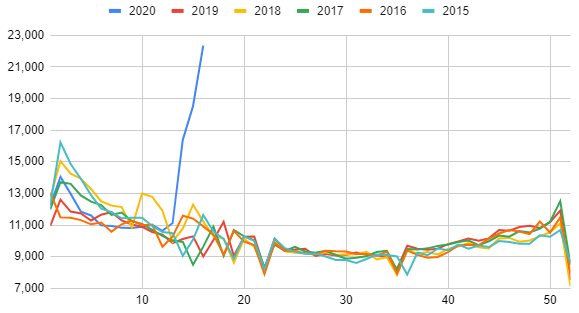
… even if the CFR is the same as that in 2018 (the yellow line) the rate of spread of Covid is clearly far faster than flu.
It is not just about 2018’s seasonal flu CFR being 0.5% and the same as Covid, it is about the initial r0 being so much higher. Which is very clearly presenting itself in the data.
A study in Germany showed 6% of people ended up being infected with the 2018 flu with no measures. The de Gaulle showed 59% of the crew actively had Covid with no measures, which supports the natural initial r0 predictions.
The evidence we need is a medical study that shows immunity to Covid in the presence of infection without showing antibodies. Silver bullet.
No, you are just wrong in your usage here. Social distancing and other measures can be either coercive or voluntary. In Sweden they are mostly voluntary in practice, though there are threats to back them up coercively which have occasionally been followed through on in a few particular cases, but are not in practice done anything like as much as in the UK.
Toby’ s point is absolutely correct and legitimate – the drop in traffic he referenced is absolutely evidence that the coercive lockdown was not needed.
On reread I agree with you my opening sentence should have read “mitigation measures” not “social distancing”… in my defence the plots he quotes against Ferguson are “mitigation” prediction plots, and Toby talks about them “social distancing” and lists they are just: – washing hands – staying 2m apart – still going to work and socialising – not seeing grandparents – and, not doing too much more. I agree by Ferguson’s actual definition, this is the act of not going to work or seeing people, and we do all need to be clearer about terminology, I will endeavour to do so. Having tried to dig myself out of a loose tongued hole… … and addressing the substance of your point. He did not show any commuter data for Sweden, I did, and it clearly shows that 65% are not commuting anymore. So by the distinction between “mitigation” (the measures above) and “suppression”, which about limiting freedoms. Sweden are in a voluntary “lockdown”. He seems to be accepting we can ignore the principles and benefit of a lockdown, voluntary or coercive, in both countries whilst denying Sweden is in one and claiming ours was never needed. Which I find duplicitous. More… Read more »
The difference between what the Ferguson model predicted for Sweden and the reality is scandalous.
Actually. How that man is still in a job, let lone advising gvts, is beyond me
Sweden has seen a 65% reduction in commuter traffic (vs our 80%).
They are in an suppression strategy (voluntary lockdown).
My understanding is that the yellow prediction did NOT include this level of measure. So I think this plot is the graph equivalent of a misquote. My understanding is he made a suppression prediction, but for some reason they left it off the plot.
Can you clarify what you think the difference between suppression and mitigation is? I quite get your point that the reality is similar but there is a huge difference between being forced and being asked to do something. They are still attending pubs and restaurants. Their children are attending schools. Where possible they are working from home, and traffic has dropped as a result.
The point is that there are similarities but also massive differences between their suppression and ours. I suspect their suppression looks much like our mitigation.
I know where I’d rather live.
I just don’t want to participate in something dishonest. It doesn’t make clear which of the many permutations Ferguson explored, it just calls it “moderate”. If we look at the plot from his paper to work out what it might be… https://www.imperial.ac.uk/media/imperial-college/medicine/sph/ide/gida-fellowships/Imperial-College-COVID19-NPI-modelling-16-03-2020.pdf?source=Alphaville Referring to his code from page 6, if you took out PC (School closure) it might look like a: – Hand washing – CI: Case Isolation, staying at home for 7 days – HQ: Case Isolation with household quarantining, the 14 day whole house thing BUT, nothing more, so NOT: – PC: school closure – SDO: social distancing of > 70 – SD: social distancing of entire population = working from home The blue line includes PC and SDO, but NOT SD, and it is relatively way lower than the yellow one in Toby’s plot. From this other plot in the doc…?source=Alphaville … in the blue section SD squashes the line down below the red line so you’d be looking at Ferguson’s prediction being pretty much what Sweden is actually seeing. Which is why I find this plot so distasteful as it is just not an accurate representation of what he said, and therefore for me FAKE NEWS.… Read more »
Two plots failed to inline…
https://pbs.twimg.com/media/ETQSsWfX0AEyxLV?format=png&name=900×900
https://pbs.twimg.com/media/ETQSsYYWsAEHK56?format=png&name=900×900
I quite agree Simon; we need the strongest and most unassailable case to end the lockdown, any comparison with Sweden needs to be done with caution and facts. I think it is an important data point though, maybe you could draw up a skeptical primer for Sweden?
For example what can we say about their death curve? It’s clearly been suppressed by their measures (or something inherent in the virus) enough to prevent exponential growth.
It’s not solely about their population density, it’s not dissimilar to the UK’s in areas where they actually live.
There are social differences though, it would be hard to account for them.
Their measures are maybe better targeted? They allow for a more normal life. They are not having to borrow as much as other countries. The education of more of their children is less disrupted.
Can they be a model for the UK? How might that look?
What do you think we can draw from Sweden to advance a lockdown skeptical position?
We don’t really know why their new case growth is still slightly growing, it is for sure that they have less strict suppression measures, my gut feeling is something about their demographics meant they needed less strong measures. This is based on observing that our new case growth rate was much higher before. Given they haven’t quite got r0 8.28% spread – Sweden: deaths 264/1m -> 5.28% spread … but, we could really do with adjusting for the death demographics in more detail than that. IF, we believe the theory that a higher suppression lowers the artificial herd immunity ceiling, all we can say is: – UK: having r01 is not much above 1. So theirs might end up being similar to our with weaker measures, suggesting that liek we saw with the new case grwoth rate something about their society means its natural capacity to spread is less aggressive. Saying more than that from the observed data, is just speculating. BUT, the IFs are predicated on getting a concrete answer (and in my view we don’t have one yet) as to whether: 1) suppressing transmission dynamics burned the infection out 2) it would have happened anyway as serology surveys… Read more »
WordPress has just garbled that post, top section should read… We don’t really know why their new case growth is still slightly growing, it is for sure that they have less strict suppression measures, my gut feeling is something about their demographics meant they needed less strong measures. This is based on observing that our new case growth rate was much higher before. Given they haven’t quite got r0<1, so we would probably have reall struggled to keep the NHS below ICU capacity. Reality is we might learn something from looking at the sorts of demographics Ferguson is using to vary the impact of r0 in his model, but we can't discuss him without lynching him so this is probably a bad point to make… IF, we believe a Robbio/Gangelt/NY CFR of 0.5%: – UK: deaths 414/1m = 8.28% spread – Sweden: deaths 264/1m = 5.28% spread BUT, we could really do with adjusting for the death demographics in more detail than that. IF, we believe the theory that a higher suppression lowers the artificial herd immunity ceiling, all we can say is: – UK: having r0 1 means they are not quite halfway there yet, but close as it… Read more »
Not that I am a fan of the WHO but their advice on distancing has changed from 2 m to 1 m.
https://www.who.int/emergencies/diseases/novel-coronavirus-2019/advice-for-public
So, perhaps the governments who have used their previous guidance can update.
A few thoughts for the day: Airlines – I imagine the ‘big three’ middle eastern airlines will be the beneficiaries of the current situation, maybe the Asian airlines. They will have the resourcing and government backing to put in place whatever ‘health theatre’ measures governments demand to complement the ‘security theatre’ we have to put up with. And international travel will return! Of course, I imagine the BoJo administration won’t do anything to help our UK airlines, due to their free market principles and their need to appease the Guardian. Meanwhile British jobs gone… Local anomalies – I was looking at these local ‘Rona death maps that have appeared in a few papers. I expected my Great Western/Thames Valley town to feature quite strongly in the death stakes. In fact the situation was better than I thought, but there are some anomalies. For example, Didcot and the surrounding villages register no deaths, despite Didcot being very well connected to London and well within the commuter belt. On the other hand, Abingdon, not on the railway system and rather popular with Oxford University staff, has been much harder hit. Reading wasn’t as bad as I expected either.. Slough seems to have… Read more »
The dissenting Mumsnet thread got shut!
https://www.mumsnet.com/Talk/coronavirus/3886452-The-hospital-I-work-in-is-so-quiet?pg=40
I’d seen that thread referenced over at Guido’s place on order-order, but hadn’t visited, closed eh? Someone has either been lent on or raw nerve touched. Mumsnet not exactly being a beacon of reasonable-ness…
I’ve just checked the link and it’s still there.
I may have gone for a drive this morning into the neighbouring town to get shopping. Because I was lazy (this town is literally teo miles down the road).
On my way there and back I counted the number of walkers and cyclists I saw both in the town (a small town with a small high street) and in the area from my town to them. It was 118 going, 124 coming back. It was relatively packed with footfall. I’d say probably twice as busy as I’ve previously seen it on a sunny Saturday morning.
Now round here people have never been very zealoty – but generally obedient I’d say. But I’d say we’ve had a distinct change in mood since a few weeks ago. There is dissent in the ranks.
It also leads me to question the lockdown rules in general in the sense that – is encouraging twice as many people to walk around a small town as there would normally be (because they can’t go anywhere or do anything else) really more ‘socially distanced’ than letting people drive to their local shopping centre and wander round for a few hours?
It sounds like we’re seeing quite similar effects! Like I said I’m puzzled at the disconnect between peoples actions and the apparent YouGov results… I also agree that the social distancing aspect is difficult in practice. My commuter town is pretty densely packed at the best of times and with travel restrictions people who would normally buzz off elsewhere are hanging around the pavements and local paths…. How the cabinet and civil servants expect ‘social distancing’ to be adhered to for, potentially, years is beyond me. Academic fantasy land, and I work there…
I visited a local garden centre (still trading because it contains a farm shop) on the first weekend of lockdown and it had about 1/10 of the usual number of customers. Today the car park was as full as it would be on a normal Saturday, however I would also say that my visit took about twice as long as usual due to the social distancing queues in place. So probably about 50% of usual number of customers, up from 10% five weeks ago. If the police raided it they’d find few of the customers were buying anything “essential”.
A local garden centre has been staging a very brave protest against the lockdown, including staying open despite police intimidation and action from the local council. Purely trying to stave off bankruptcy. They also have a change.org petition. Details below. I was there yesterday and it has a lot of local support. Given its size and structure there are no issues with Social distancing, and it is arguing that it falls within the definition of a hardware store.
https://www.growndirect.co.uk/
NEW TODAY
Fascinating alternative perspective from Nobel prize-winning Stanford Prof Michael Levitt. He believes the Covid-19 epidemic was never truly exponential, and that outbreaks naturally start slowing down regardless of govt interventions:
https://t.co/z77bwNyGic
https://twitter.com/freddiesayers/status/1256552040202932224?s=19
The tweets in response stating “yeah but he’s not an epidemiologist”… Neither is Prof Neil Ferguson
Actually this is what was discovered by William Farr in the 1840s, long before computers and before much was known about the actual microbes that cause infectious diseases. He showed that all epidemics, when cases numbers are plotted over time, follow a Gaussian or normal distribution, popularly known as a “bell curve”.
Now if all you can “see” is the extreme, bottom left corner of the bell, it is indistinguishable from an exponential curve that theoretically goes ever onwards and upwards to infinity. This is when the media usually gets hold of the story. They assume that the initial tens, hundreds and thousands must invariably become millions, then absolutely everyone.
But as soon as the rate of growth starts to slow, even though the numbers are still increasing day by day, you can make a stab at calculating the overall size of the bell. And that is usually much smaller than the total population. Which is proving to be the case for all European countries today.
Hello, greetings from a new member! It has been really interesting to read the daily updates and the discussions which are taking place through the comment section. Thank you Toby – the daily summary is so helpful.
I was just wondering if anyone has a good (easy to understand) explanation of how R0 is calculated. I have tried researching this online, but can’t find a clear account of how it is arrived at. It seems to be cloaked in secrecy and simply announced (along with warnings that it could change at any time). I would like to try to understand it as it seems to be a critical factor in what happens next. Thanks!
You and me both. It seems to me like they just pluck this fabled R-garbage out of the air, seeing as they can’t possibly know how many people are actually infected at any one time
Who gives a shit? It’s all macguffin bollocks based upon cooked up numbers to keep the sheep in line
I think you just have to guess it from the data.
If you know the number of new cases per day at the start of the epidemic (before there’s much immunity) and know the average number of days people are infectious for you can estimate it from those two things.
It isn’t just a property of the virus itself because it’s a count of how many other people each person infects. That depends on whether they use public transport, sneeze all over everyone, how densely populated the place they live in is, whether they wash their hands, etc., as much as it does on how easy it is to catch the virus. It will also therefore vary in different places being much higher in big cities with public transport than in small villages.
https://www.lbc.co.uk/radio/presenters/maajid-nawaz/media-misguiding-death-toll-misinformation/
More important is 23rd May – the end of Ramadan! How is HMG going to manage this?
While I was angry before, I am even angrier today. We took a bike ride to Hyde Park with our young son and sat down in the grass to change his diaper. Stasi immediately approached and ordered us to get up. Keep in mind the next human was maybe 10 meters away. How people can take this is beyond me – and for what???? I truly hope Simon’s lawsuit goes somewhere, or at least serves as a wake-up call.
Brace yourselves, lockdown has gone woker than woke (he would be posh, wouldn’t he? Not sure kids who’ve been locked in a council high rise for the last God knows how long will be sharing his sentiments) https://www.youtube.com/watch?v=bea4jCAkXsI “Daddy, tell me the story about the virus”
Mr Young
2 lines above the graph you wrote
“In fact, as of April 29th, Sweden’s death toll from COVID-19 was 2,462,”
Did you mean “with Covid”?