

Johan Giesecke, an advisor to the Director General of the WHO, former Chief Scientist of the EU Centre for Disease Control, and former state epidemiologist of Sweden, returned to UnHerd yesterday to resume his discussion with editor Freddie Sayers, adjourned a year ago. He was one of the first major figures to come out against lockdowns last spring, saying they are not evidence-based, the correct policy is to protect the old and the frail only, and the Imperial College modelling was “not very good”.
While he admits he made some mistakes, he believes that history will judge him kindly, and says: “I think I got most of the things right, actually.”
He gives a solid defence of the outcome in Sweden, ably batting away the “neighbour argument” that says Sweden failed because Norway and Finland did better.
The differences between Sweden and its neighbours are much bigger than people realise from the outside – different systems, different cultural traditions…If you compare Sweden to other European countries [such as the UK, France, Spain, Italy, Belgium] it’s the other way round. On the ranking of excess mortality, Sweden is somewhere in the middle or below the middle of European countries. So I think it’s really Norway and Finland that are the outliers more than Sweden. … They’re more sparsely populated. There are less people per square kilometre in these two countries. There are also much fewer people who were born outside Europe living in these two countries.
He is also rightly dismissive of the charge that Sweden is currently the worst for infections in Europe. While positive cases are up, so is testing, and besides on the most important metric, excess deaths, Sweden has been far below average since the start of February.
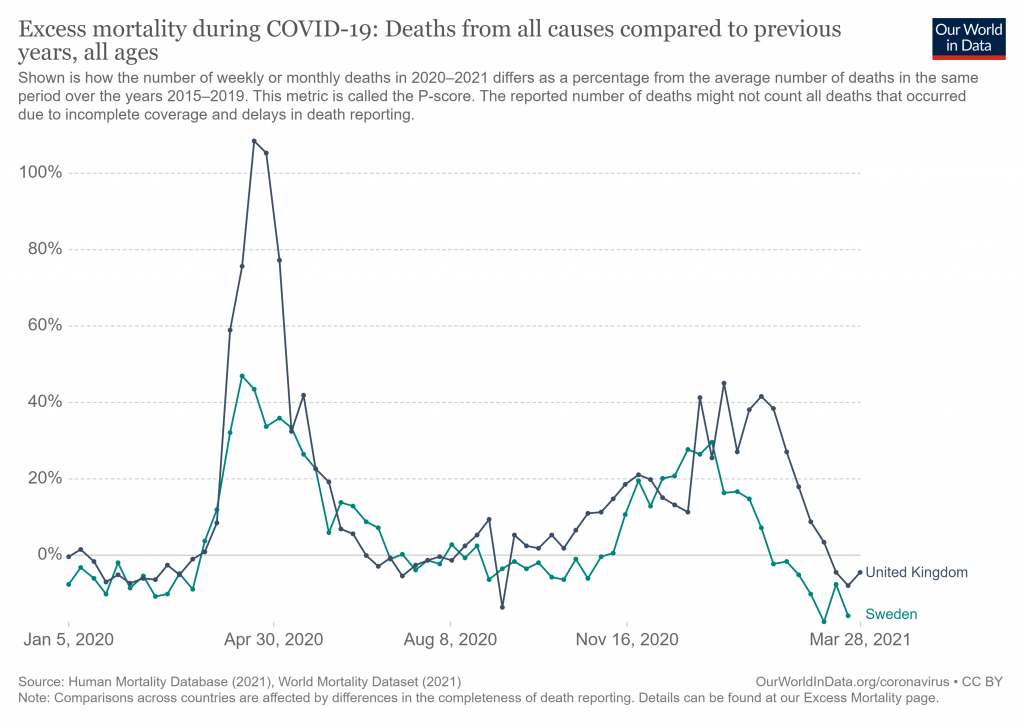
Giesecke is direct in his unflattering comparison of the UK’s outcome with Sweden’s:
They’re very similar. And yet one of the countries has had three severe lockdowns and the other has only had voluntary or mostly voluntary measures. That tells us something I think. That lockdowns may not be a very useful tool in the long run.
He admits that he misjudged how quickly vaccines would become available, and is now quite the enthusiast. He has had the AstraZeneca jab and wants everyone to have it: “If we really want to get down to small numbers – we won’t eradicate it, but to small numbers – then I think even children should be vaccinated… I can’t see why not.” He sees vaccines as providing a way out:
If you are vaccinated with two doses and wait the right number of weeks, then… you should be able to live like you did before the pandemic. This disease is sometimes seen as something supernatural, mystical, mythical – but it’s a viral disease like all other diseases. More dangerous than some of them, but it’s not unique, Covid. So a proper vaccine used correctly protects you and means that you don’t infect other people as well…. No vaccine is 100% effective, but we don’t have this discussion about any other vaccine.
He is full of praise for the Swedish approach, and in that his liberal motivations are clear.
Look at the good things with the Swedish system…. One is the schools: we are not destroying the future for classes of children. Another is that Sweden kept to its international agreements — for example in the EU you are not supposed to close your borders with other countries, but that has happened in several countries in Europe. We have made it possible for small businesses like cafes or bicycle shops to survive the pandemic. We have kept democracy. We have trusted people. I think there are a number of benefits from not having a severe lockdown and more of them will come as we do research on this in the future.
He is dismayed by how readily people surrendered their liberty – even in Sweden. A new law has recently been passed giving the Government the power to lock down in the future if it deems it necessary.
People were willing to give up more freedom than I thought they would. It worries me — there are many democratic rules and freedoms that have been curtailed. I think that may be one of the dangerous results of this pandemic.
There is a new law — a pandemic law — which gives the Government more power than it had before, and curtails part of the freedom of the Swedish population… It’s shifted power away from parliament to some extent, which is a new thing in Sweden at least in peacetime.
During the interview Giesecke makes a number of concessions, some of which are more understandable than others. He accepts his predictions about population antibody prevalence were too high, which is fair enough. But he still appears to regard antibodies as the definitive indicator of spread, despite the considerable evidence that a significant proportion of people are exposed or infected but do not develop antibodies because they fight it off with other parts of their immune system, such as T cells. He also seems oddly unfamiliar with the scientific literature on the ineffectiveness of lockdowns, appearing to accept that they may make a difference.
One of the things I got wrong a year ago is the rate of spread of this disease. I thought it would spread quicker. And I also thought it would be more similar in different countries. We can see now that there are big differences in the rates of spread in between countries. It may have to do with lockdown, it may have to do with cultural things in these countries. But there is a big difference between countries.
He also argues that Sweden effectively did lock down, just voluntarily, saying the country had “severe restrictions”.
Sweden has had rather severe restrictions, but we based them on voluntary participation by the inhabitants instead of using laws and police. A lot of people in the world seem to think that Sweden did nothing about the Covid pandemic. That’s wrong. The entire population changed their way of living and it had profound effects on daily life for millions of Swedes, even though you weren’t fined if you were in the wrong place at the wrong time. So I would still advocate the Swedish model, even knowing all that.
The problem with this argument is that it essentially accepts the lockdowner position, that “severe” lockdowns are necessary and effective, and that the only reason Sweden could get away without one is because they did it without being forced to. It also suggests going back to normal will be fraught with risk of resurgence. These ideas are not supported by evidence, such as the evidence from US states that reopened last year and stayed open throughout the winter.
Giesecke also seems to concede Sayers’s bizarre claim that Neil Ferguson’s forecasts – of up to 510,000 deaths in the UK from an unmitigated epidemic, 250,000 from a mitigated epidemic and 20,000 with a suppression strategy – were accurate. “You may be right,” he says. “There is quite a difference between half a million and 130,000 – but, yep.”
There certainly is a difference between between 510,000 and 130,000 – a multiple of four in fact – and it’s mathematically illiterate for Sayers to suggest otherwise. Unless, of course, you assume that the lockdowns have prevented hundreds of thousands more deaths. Which lockdowners do believe, naturally, as a fundamental article of faith, despite the clear evidence from places like South Dakota and Florida that did not lock down that they are mistaken. Indeed, Ferguson’s modelling was applied to Sweden by a team at Uppsala University and the predictions were laughably wrong – they predicted 96,000 deaths by the end of June if Sweden stuck with its current policy; the actual figure was 5,333. Sayers makes no mention of this modelling embarrassment, and Giesecke does not draw his attention to it.
But perhaps Giesecke was just being polite to an interviewer who, for all his admirable open-mindedness in who he is willing to interview, does not seem to have developed antibodies to the evidence-free lockdowner ideology. Sayers even claims at one point that the Infection Fatality Rate for the UK and Sweden is as high as 0.9%. A recent meta-analysis by Professor John Ioannidis concluded that the IFR in Europe is more like 0.3%-0.4% (0.15% globally). Sayers doesn’t say where he gets the 0.9% figure from.
The interview is well worth watching in full.






To join in with the discussion please make a donation to The Daily Sceptic.
Profanity and abuse will be removed and may lead to a permanent ban.
I’ll need to watch this interview again – and probably pay closer attention – but I was wondering throughout whether this was the same guy I saw being interviewed a year ago. My tin-foil tendencies went into overdrive and I found myself thinking he’d been pressured in some way. He seemed kind of “broken”.
There were quite a few things that set my bullshit meter tingling. His promotion of child vaccination was truly bizarre. Kids are at negligible risk from covid. They’re more at risk from flu and yet we’ve never seen some intense pressure to vaccinate kids for flu. And we still have to keep firmly in mind that covid does not constitute, and never has constituted, a public health “emergency” in any rational sense of that word. 99.7% in Europe survive this thing.
Even Ioaniddis’ IFR for Europe is probably inflated because of the curious way we’ve been recording covid deaths. One can only wonder what we would see if every death within 28 days of taking the vaccine were to be recorded as a “vaccine death”. But no one would do that because it would be crazy, right?
Same thoughts here. There is some odd stuff, when judged in the light of his previous cool analyses.
“one can only wonder what we would see if every death within 28 days of taking the vaccine were to be recorded as a “vaccine death”. “
I wonder if there is a way to actually get hold of this data? And then compare it with deaths within 28 days of a positive test over the same period. Could be a game-changer!
“Could be a game-changer!”
Probably not, given the mountain of ignored evidence about the falsity of the Covid narrative.
It may be obtainable with a Freedom of Information request. Health authorities must hold the raw data, since they’re just dates of death and dates of injection, for identified individuals.
Maybe we need more time to gain more hindsight and will eventually see that similarity between countries, irrespective of measures taken, that he first spoke of a year ago….like water settling to a level. Though with vaccines adding to the mix that may not be possible.
Splendid, critical review Will.
Seems Giesecke still mainly is a Big Pharma/WHO shill.
On the main differences between Norway/Finland and Sweden I would add that the former are basically islands/peninsulas economically, which made it possible to shut the borders early and, above all, keep them shut.
Whether that will now turn them and OZ/NZ into North Sentinel Islands remains to be seen, but is very likely.
His unwoke comment about the higher proportion of immigrants in Sweden is also a key Covid differentiator.
2/3rds to 3/4 of ICU patients in Germany in the second wave are middle aged, very obese immigrants- a fact, but only mentioned in a hush.
“Giesecke still mainly is a Big Pharma/WHO shill.”
Far too simplistic. Why would he have stuck his neck out last year?
And “His unwoke comment about the higher proportion of immigrants in Sweden is also a key Covid differentiator.“
… is another example of blinkered perception. The role of ethnicity has been a crucial, factual observation re. Covid, and has nothing to do with ‘wokeness’ or otherwise. It has been to the forefront in the discussion of Vitmin D.
Not impressed by Giesecke. He seems rather vague and unfocused. I think it is correct as he says, that Sweden did many SD things, way more than realized by many. To compare a LD country to a non LD country it would be better to compare with Belarus. There is a paradox here that in Sweden since last year’s end , there has been a movement of opinion wishing they had LD and use of masks and all the other nonsense. The change of law points in that direction. He and Tegnell have not escaped criticism, which has increased over the last months. His promotion of vaccine is a bit strange coming from a country which during the last pandemic(Swine flu) was one of the most enthusiastic for the Pandemrix vaccine and suffered severe consequences. It could be pandemic tiredness and let us hope the vaccine will finish it mentality. His promotion of childhood vaccination is bizarre in a country with the best evidence of C-19 sparing the children. He can’t be unaware of the many caveats with the immunity of the vaccines , which now everything points to be short and using the vaccines in an ongoing pandemic peak… Read more »
You’ve encapsulated most of my thoughts, swedenborg. I think Giesecke was measured and thoughtful last year, but there is an odd sort of crumbling in this interview – particularly on vaccines, with views unsupported by any bottom-line data that I have been able to dig out.
Sweden remains a comparative success without exhibiting common stupidities, with deaths that are far from being particularly high. As you say, it originally resisted the PCR scamdemics. So why this crumbling? I really don’t know – except that it is in line with the result of the sort of sinister psychological pressure that has been widespread.
As to Freddie Sayers – I have often been quite impressed by his interviewing, but he has always been a conformist, which has shaped his commentary on the interview. Unherd, generally, doesn’t rock any boats to a great degree.
Yes he seemed utterly broken, no mention of the fact that the vaccine is still in trial phase, no sense of the diminishing returns of vaccinating people at near-zero risk, and completely missing the point that Ferguson was claiming lockdown would ‘save’ nearly half a million lives (500,000 with no measures, 20,000 with lockdown), a claim that was dubious at the time and is now demonstrably false, espcially when you include lockdown deaths, now and in the future. And you would expect an epidemiologist to at least show some interest in the theories about the potential harm ‘slowing the spread’ and preventing natural herd immunity from building up might have done in terms of prolonging the pandemic and harming the most vulnerable. Sounded like he has been ‘got at’. Also disappointed in Freddie Sayers – I listened to this yesterday and immediately deleted ‘Lockdown TV’ from my podcast reader
I agree with you. Most odd is the pretense that the efficacy of vaccines is established, when it clearly isn’t. Quite the reverse when you drill down.
But then I see this podcast from Dan Astin-Gregory :
“Coincidence’ – What does the data say” (see Roundup)
… and, whilst he’s not in the same league as Giesecke, and is giving a run-down on the actual data re. vaccines in a very creditable way, note how he is almost apologetic and eager not to offend.
This is a good example of the second layer of intimidation that is going on.
He’s always afraid of being taken down by YT. I can understand this, given their zero tolerance of wrongthink.
Good morning everyone,
I haven’t posted on LDS since they sadly changed the format from the old message board.
I must admit, I haven’t seen the new interview with Giesecke yet (only just reading the transcripts in the article above), but still vividly recall the first one last April, as back then apart from OffGuardian, Peter Hitchens and a few others, it was the strongest and clearest sign that something was clearly very, very wrong with the response.
It’s interesting to read a number of you feel that he now seems more “on-board” with the narrative.
Is it simply the case that his WHO promotion in September has had that effect?
https://unherd.com/thepost/johan-giesecke-gets-new-role-at-who/
https://www.telegraph.co.uk/news/2020/09/01/architect-swedens-covid-policy-given-promotion/
https://www.newsweek.com/sweden-herd-immunity-mastermind-who-promotion-1529111
One might be tempted to look towards the famous Upton Sinclair quote for guidance on this.
“It is difficult to get a man to understand something, when his salary depends on his not understanding it.”
Just a thought.
Cheers
Simon
AAArrgghh. STOP telling me what is worth watching or reading in full. My blood pressure simply won’t take it!