


A new study (not yet peer-reviewed) of over 50,000 employees of the healthcare system in Cleveland, Ohio, has found that previous infection provides very robust protection against re-infection and, importantly, that there is no gain to being vaccinated as well.
U.S. Senator Rand Paul tweeted the study’s conclusion: that it means vaccines should be prioritised for the not-previously-infected at home and abroad, not wasted on the already immune.
The confirmation of the protection provided by natural infection is very welcome, as is the finding that vaccinating the previously infected is superfluous. Given the significantly higher risk of adverse events for those previously infected (up to three times higher according to the ZOE Lancet study) and the world shortage of vaccines, there would seem to be a moral imperative to cease vaccinating the previously infected.
The study’s finding is particularly robust because of the large sample size and because there were zero instances of re-infection among the previously infected (both vaccinated and unvaccinated). This was despite the study period beginning at the peak of Ohio’s winter wave, so the unvaccinated had plenty of exposure to the virus. Other studies have found the relative risk reduction offered by previous infection to be 80% against all re-infection and 90% against symptomatic re-infection, so the results in this study were even higher than usually observed.
However, the study’s findings for vaccine effectiveness in the not-previously-infected are much less reliable.
The first thing to say is the reporting of the results is frustratingly minimal. There are no tables to go with the figures so you are left trying to read numbers off graphs. There is also no breakdown for first dose and second dose – people are counted as unvaccinated right up until 14 days after their second dose. This means all the infections people get after their jabs, including in any post-vaccination infection spike, get counted as unvaccinated infections.
Looking at only the not-previously-infected now (in whom all 2,154 infections in the study occurred), the study found 2,139 infections among the unvaccinated versus just 15 among the vaccinated. Unfortunately, we can’t do a simple calculation for vaccine effectiveness from this because the populations these infections occurred in changed by the day as people moved from the unvaccinated to vaccinated cohorts, and the authors did not convert the figures into person-days or similar to take that into account. This means we can’t say it was 2,139 infections out of so many people, and likewise with the 15 infections, to allow a straightforward comparison of infection rates among vaccinated and unvaccinated.
What we can do though is observe in the plot below that most of the infections in the study occurred before day 50 of the study period, at at time when (almost) no one was vaccinated – the numbers beneath the plot show that most people became vaccinated between days 60 and 80 (when the number vaccinated jumps from 7,392 to 24,989; note that in this kind of plot the cumulative incidence can change due to people moving from one category to another and not just because of new infections). This means the comparison of the number of infections in the two cohorts is heavily skewed by the much longer time period for the unvaccinated group and the fact that most infections occurred prior to (almost) anyone being vaccinated.
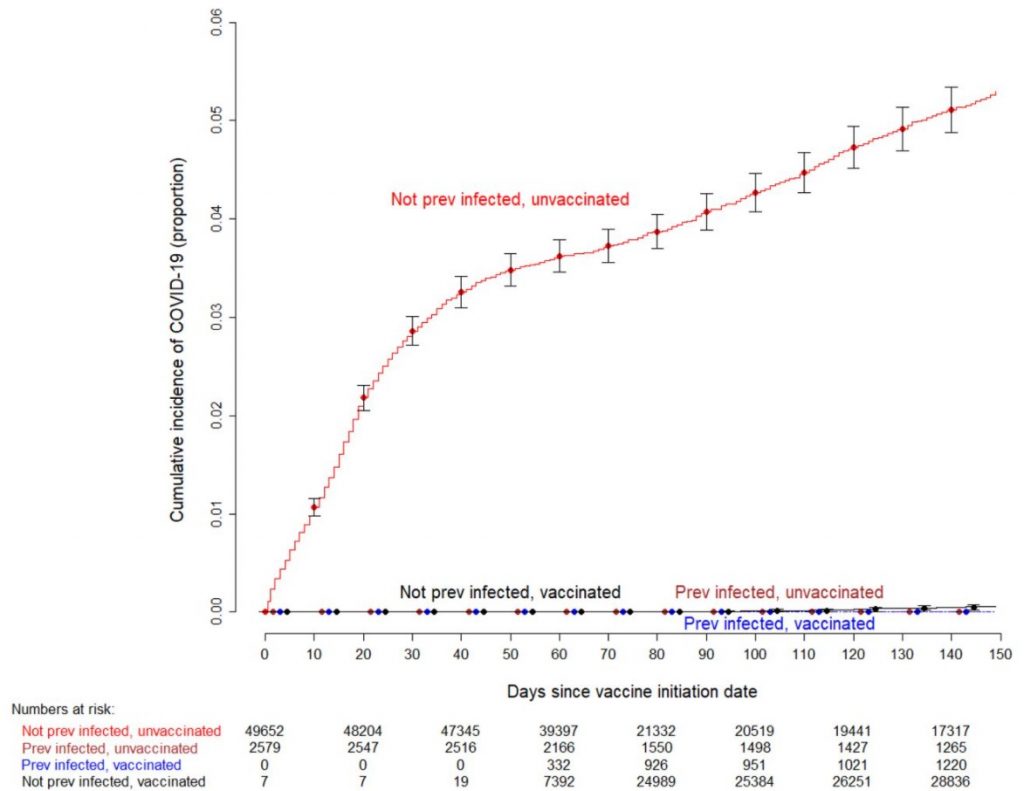
The authors state that they adjust for the “phase of the epidemic”, which is done by making changes according to the steepness of “the slope of the epidemic curve”. However, the steepness of the slope does not by itself tell you the background prevalence (just how fast infections are rising or falling) so it’s not clear that this adjustment will properly take into account the difference in incidence at different times. In any case, it does not take into account that the exposure time for the unvaccinated cohort is much longer than for the vaccinated cohort. The authors do not indicate that they adjust for anything else.
This means that the reported 0.031 hazard ratio for the vaccinated group, which translates to a 96.9% vaccine effectiveness (relative risk reduction of Covid infection), needs to be taken with a pinch of salt. Perhaps this is why the authors do not make anything of this finding, omitting it from their conclusions and summary. It does seem a missed opportunity, though, with data as detailed as the authors had access to, not to have designed a study that could reach a more reliable answer on vaccine effectiveness.
So in summary: the headline results about immunity through previous infection being robust and vaccination not adding anything to it are sound. But don’t try to get anything else out of it in terms of vaccine effectiveness because the analysis is not careful enough to tell you anything reliable.




To join in with the discussion please make a donation to The Daily Sceptic.
Profanity and abuse will be removed and may lead to a permanent ban.
It sounds like they’re not being very thorough in these studies. (Why don’t they teach logic in these schools?). How hard can it be to give the detailed information that would allow for more meaningful conclusions? In any case, I’ve no idea whether I’ve had SARS-CoV-2 or not, and have no plans to get tested because: mass testing is keeping this scam going; because there are possible health risks to taking large numbers of these tests; and because it is invasive, unpleasant and a lot of hassle to do so and I do not consent (and I don’t know for sure what they do with my dna). As for “vaccines”, at our very sceptical prayer group, we were told (by a “religious leader”) that so far as he was concerned, people from our church should not use these “vaccines” for the following reasons: 1) They are linked to abortion. 2)They are experimental gene therapy drugs. 3) They have hardly been tested. 4) Covid 19 does not carry sufficient risk to justify forced mandatory vaccination. And of course we are not the only ones. So far as I am concerned, any sort of coercion or pressure to vaccinate represents religious discrimination.… Read more »
It’s just bizarre that anyone feels the need to do a study to come to this conclusion.
In a way, yes, but go on to any website that is pushing the vaccines and they will all say in their FAQ that you need to get jabbed regardless becuase “it’s unclear how long the protection lasts from natural infection, and how strong it is” (a bit like from the vaccines then).
Yes, the denial of natural immunity was at the very beginning of The Great Vax Conspiracy, and one of the earliest warning flags.
Most people fell for the lies and think it doesn’t work. Amazing.
I remember BBC and ITN made great hay with reports that someone had been infected with covid again after recovering from it – hint hint recovering from it doesn’t protect you and only a jab can save us
“it’s unclear how long the protection lasts from natural infection, and how strong it is”
Which either means people’s immune systems work completely differently with regard to this virus compared to any others,
Or, they’re lying.
Of course it doesn’t!!
It’s not possible to beat naturally acquired immunity because that activates every pathway in the immune system.
Worse, vaccinating the infection recovered population brings about more severe adverse effects of vaccination,
That’s an interesting question actually. With VITT (the nasty blood clots) most people test negative for anti-N abs, but there haven’t been enough tests to be sure. It seems that Covid might protect you from VITT. Possibly also why there were more cases in Norway (although it’s equally likely they were just denying them less).
A vaccine after you’ve had Covid does boost the crap out of your antibodies. But this isn’t necessarily actually a good thing– it might mean more “Original Antigenic Sin” the next time you get Covid in 5 years.
It’s also clear that at pretty much any age the risk from vax side-effects is higher than that from C19 reinfection.
Wow. At pretty much any age… The whole roll out was pointless and damaging then, even for the old. Covid might protect from VITT because most get a light dose, on the outside of the nasal lining for example I assume, and the immune system revs up at once and usually stops it before it replicates massively and gets into a whole lot of places it shouldn’t. Whereas the vaccines put the spikes in quantity straight into the bloodstream and all kinda organs before the immune system has got going. Is that very crude summary what might be happening? Re OAS, I had Covid March 2020, very nasty but not worse than very, very bad flu. I think I have been reinfected once since, last autumn, when I suddenly was felt so ill and tired I had to sleep c 24 hours. Which I never do. Then I was fine. I think a tiny dose of the then new variant had reached me, and my immune system laid me out to fight it off. ie, a natural booster jab. No Original Antigenic Sin effect. It felt like you often do in the winter – “Ooh, I feel terrible, as if… Read more »
This is a poorly designed retrospective study which has essentially little to offer. The fact however that it is questioning the antibody response to individuals after vaccination who are known to have antibodies is bizarre. When our leader proudly claims to be “bursting with antibodies” and then has a vaccination for the disease ;it turns medical understanding on its head. There is so much gobbledygook and scaremongering published and uttered by our leaders, media,SAGE and SPY B that common sense and understanding are rare commodities. Although LOCKDOWN SKEPTICS is an echo chamber of similar opinions-thank goodness it exist to demonstrate that not all the world is mad.
Oh but, oh but, stop it with your sensible study … we’ve been told by the science that we cannot rely on our bodies any more. Body bad, vaccination good.
I had a grounding in biology and epidemiology, worked in public health and HIV prevention and finally as a psychotherapist and I am appalled at the reaction to Covid, totally lost any trust in government and a lot of scientists.
Plus any trust in 80-90% of the world population!
https://www.nhs.uk/conditions/coronavirus-covid-19/testing/antibody-testing-to-check-if-youve-had-coronavirus/
An antibody test is a blood test to check if you’ve had coronavirus (COVID-19) before. This test is not widely available yet.
Because!?!?
And we have put almost no magic money into developing T Cell testing either.
Because!?!
The medical shakedown continues
£200 for a T cell test