

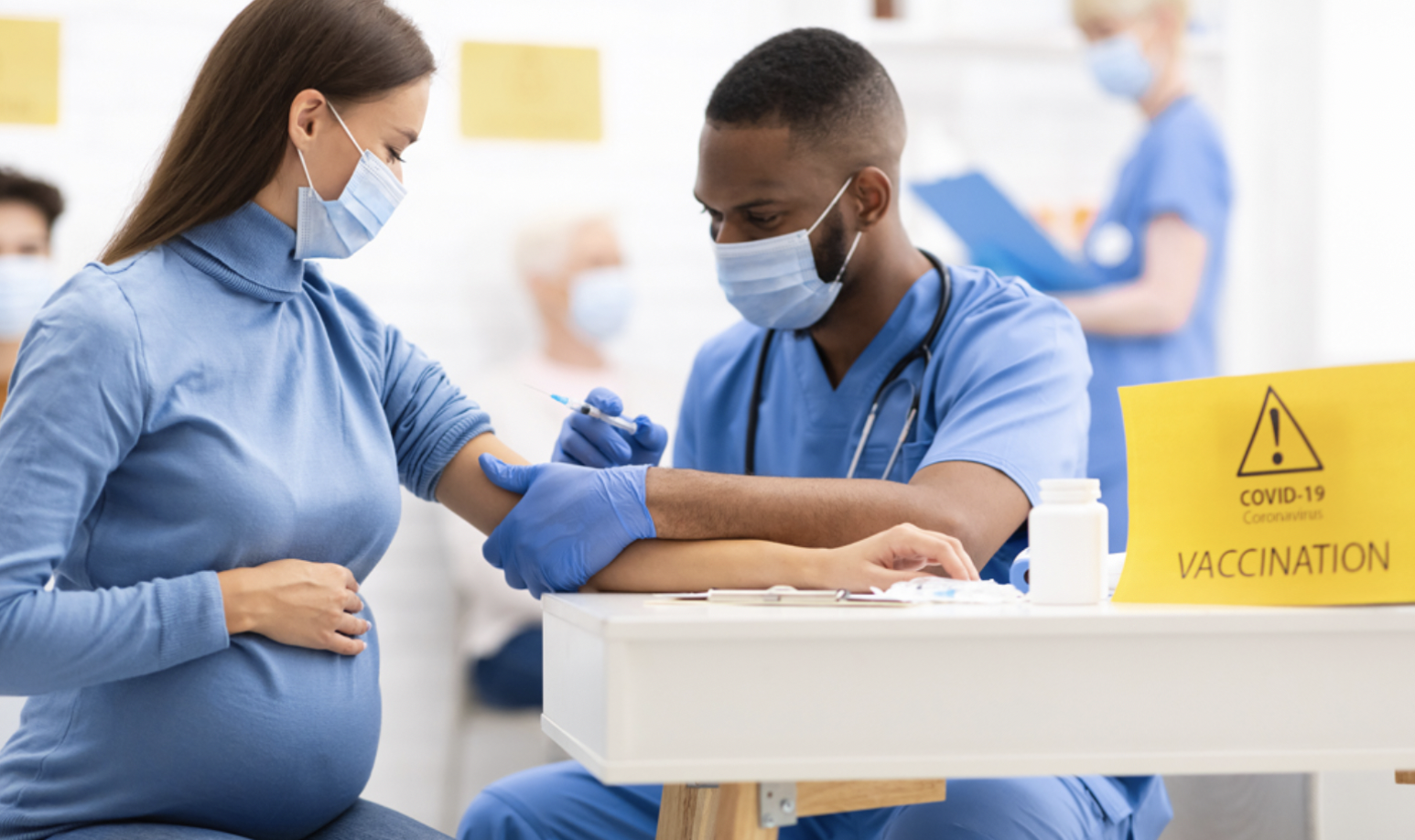
Just over 15% of pregnant women in the U.S. have had at least one dose of a Covid vaccine, according to data from the Centers for Disease Control and Prevention (CDC). Black and Hispanic mothers are up to four times less likely to have been vaccinated than white and Asian mothers. The CDC believes that vaccine hesitancy (or refusal) is likely caused by there being limited safety data available on the new vaccines. The MailOnline has the story.
Vaccination rates diverge significantly by race: 25% of Asian pregnant women and 20% of white women were vaccinated compared to 12% of Hispanic women and only six per cent of black women…
The CDC researchers expect vaccination coverage among pregnant women to increase as vaccine access continues to improve and more information on the shots’ safety becomes available.
When Covid vaccines went through clinical trials, they were not tested in pregnant or breastfeeding women despite their increased risk of severe illness or death.
Such a practice is common in clinical trials because researchers don’t want to risk the health of expecting women.
But it left these women with limited information on safety risks that the vaccines may have posed.
Regulators said the evidence on these vaccines did not raise safety concerns, yet without data specifically on pregnant women, they could not make guarantees.
Despite the limited data, when the U.S. Food and Drug Administration authorised the Pfizer vaccine for emergency use in early December, the agency said that pregnant women could choose to get vaccinated.
At the time, some scientists saw this as a major step forward for pregnant women – they could make their own healthcare decisions…
But the new data from the CDC suggest that many pregnant women in the U.S. chose not to get vaccinated, at least, not in the early months of the vaccine roll-out…
Why the low vaccination rate? The CDC researchers suggest that pregnant women may have been hesitant to get vaccinated due to the limited safety data available on the new Covid vaccines as well as potential access issues.
Older pregnant women were more likely to get vaccinated than younger women. Pregnant women between the ages of 35 and 49 had a 23% vaccination rate, compared to just a six per cent rate for ages 18 to 24.
Worth reading in full.






To join in with the discussion please make a donation to The Daily Sceptic.
Profanity and abuse will be removed and may lead to a permanent ban.
More fool them
Meanwhile here in the UK there have been:
175 spontaneous abortions (including 2 maternal deaths)
13 stillbirths/foetal deaths (including 2 maternal deaths)
reported to the Yellow Card system following vaccination with the Pfizer, AZ and Moderna jabs.
I wonder how many have not been reported. The MHRA reckons the serious adverse effects reported via Yellow Card only make up about 10% of the reality.
And how many have given birth?
And what statistics are there on reduced birth weight, etc?
And what information is there on developmental issues within the first 5 years of life?
Wife tried to talk pregnant sister in law out of it. Epic fail…. We’ll see how it goes…
If I recall, tests on 880 pregnant women resulted in 117 terminsl pregnancies
1 in 4 pregnancies are thought to result in miscarriage in the west.. we don’t know for sure the actual number because many women will miscarry without knowing they have miscarried and many women do not report it if they do know.. we know that it is at least 1 in 5 in the UK because those are reported/known about. ..so…. 117/880 wouldn’t be unusual or bad at all.. in fact it would be better than nornal.. or rather you recall wrong..
Let’s see what the stats are in a few months time.. let’s see what happens to the babies.
I spent a good while trying to crunch those figures a couple of weeks ago and had no joy. Problem is the massive decrease in miscarriage in the first trimester. Between week 4 and week 12 it dramatically decreases from 25% to 5% at week 8 to 1.7% at week 12 so in order to work out whether the study in question shows a higher than average miscarriage rate you need to make a few assumptions, those being: that unless people are actively trying to get pregnant most people will not realise until week 5 or 6 (after they’ve missed their period – and perhaps longer if they were expecting disruptions in their cycle due to the jab).That 25% at week 4 represents those who will probably never even realise that there was a fertilised egg in play (for want of a better term!) So, from my foggy memory I think it worked out that 1st trimester miscarriage after the vax (from the study I think you’re talking about) is somewhere around 8.9% – is that statistically higher than average? Without knowing at what stage each pregnancy was at it’s hard to determine but it does give pause for thought.
When I was pregnant in the 1980s, doctors didn’t want you taking any medication, at least mine didn’t.
Paracetamol were the only pain killer grudgingly recommended.
Absolutely true. It was a definite no-no to take any medication. I unexpectedly became pregnant while using Beconase(?) for sinusitis and the fear of God was put into me about what I’d done. Fortunately nothing drastic happened at all. I’m aghast at these vaccinations being given to pregnant women and to younger adults of reproductive age.
Agreed. My daughter is pregnant and suffers from hay-fever & had a debate about taking hay-fever tablets. Her ubiquitous pregnancy app (!) said she should consult her doctor before taking any tablets. Yet having the so-called vaccine is fine & dandy according to TPTB! I hasten to add that she is not going anywhere near the experimental medicine. Thank goodness.