

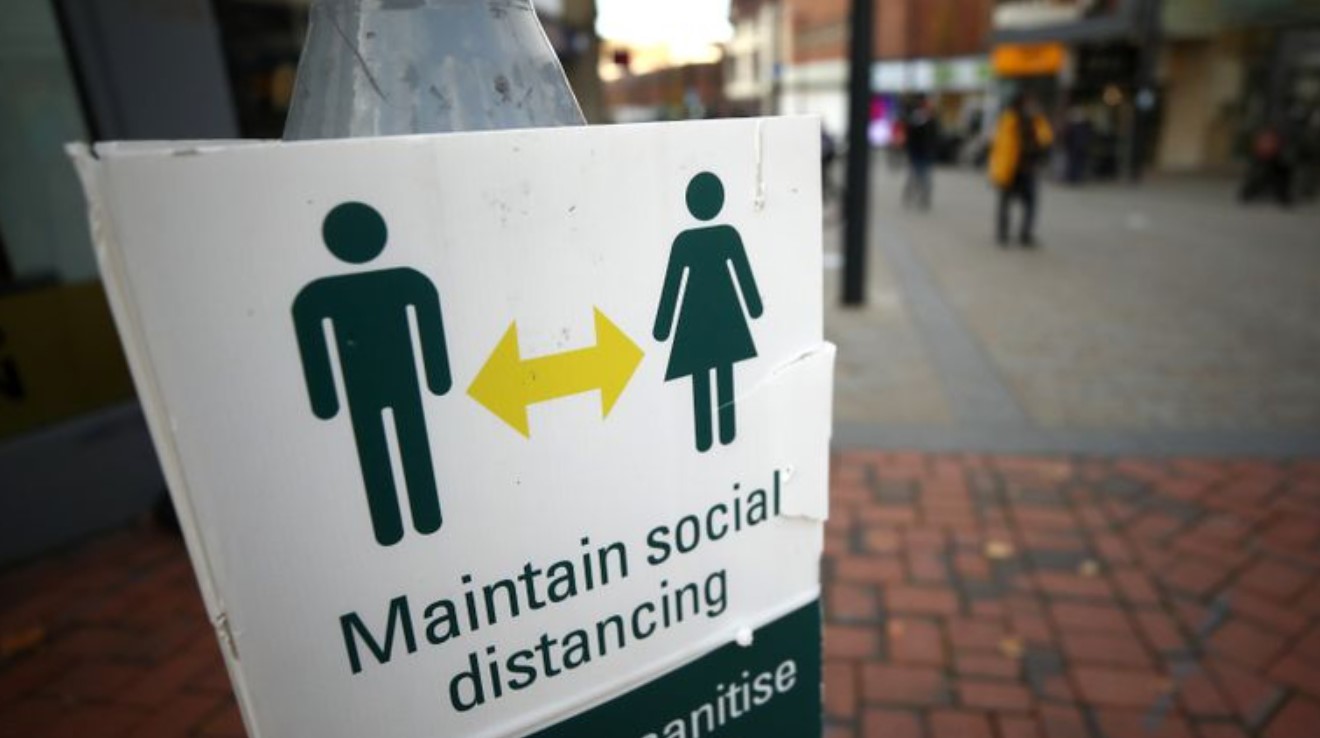
A common criticism of lockdown sceptics who draw attention to the copious data that restrictions and social distancing make little or no difference to infection rates is that we are denying “germ theory”. By which is meant that we are denying the fact that viruses are transmitted from sick people to those they come into contact with and hence that reducing those contacts will significantly reduce the infection rate.
However, this criticism fails to recognise that risk of infection is not proportional to frequency of exposure. It doesn’t take into account the counterintuitive fact that halving your exposure, say, doesn’t halve your risk of infection, not even close.
Consider the case of John, who is one of the unfortunate few who is highly susceptible to infection, so that whenever he is exposed for a non-trivial length of time he has a 0.8 (i.e., 80%) chance of being infected. Suppose that under normal circumstances he attends four places in a week where he might be exposed outside his home, maybe the supermarket, his workplace, the pub and the barber or doctor.
What is his probability of being infected during the week? It’s one minus the probability of him not being infected. The probability of him not being infected at the supermarket is 1-0.8=0.2 (to keep things simple we assume that in all four contexts he visits he is exposed to the virus). Then the probability of him also not being infected at the pub is 0.2×0.2=0.04. Then add in two more contexts where he has to avoid infection, so multiply by 0.2 twice more, and you get the answer: 1-(0.2 x 0.2 x 0.2 x 0.2)=0.998, or 99.8% risk of infection. In other words, John’s chances of getting through the week when attending four places of exposure without being infected is almost nil.
Now suppose that due to restrictions, John halves the number of places he goes where he is exposed, dropping the pub and workplace maybe but still going to the supermarket and the doctor or barber. So he halves his risk of infection, right? Wrong. That’s not how risk works when the event is a binary one (getting infected or not) that you are trying to avoid. That’s because you only have to get infected once to ‘lose’, but you have to avoid it every time to ‘win’. John’s probability of being infected during the week now is 1-(0.2 x 0.2)=0.96. So halving his amount of exposure during the week reduced his risk of infection from 99.8% to 96%, i.e., it just made it slightly less certain.
Indeed, even if John reduced his weekly exposure to just one context (say, the supermarket or the doctor) he would still have an 80% chance of being infected during the week. The only way to reduce it significantly would be to have zero exposure, but that is rarely possible for anyone. And the risk repeats week in, week out for as long as the virus remains prevalent.
Now, someone having an 80% risk of infection on exposure may be unrealistic (though presumably some people really are that susceptible). But you can reduce the risk of infection in the calculation, and also take into account the chance that you won’t always be exposed when you visit somewhere, and the basic point remains: reducing your frequency of exposure does not significantly lower your risk of infection.
This is one of the reasons that lockdowns and social distancing do not make the impact on the infection rate that many assume they will. They assume reducing exposure reduces risk proportionally, but in reality the virus is quickly able to infect almost everyone who is susceptible, largely regardless of restrictions and distancing, as they continue to be exposed in their day-to-day lives.






To join in with the discussion please make a donation to The Daily Sceptic.
Profanity and abuse will be removed and may lead to a permanent ban.
18 months ago, I would have thought this was stating the blindingly obvious.
You and me both. Bad v good. Bad only has to win once.
I’ve been saying something similar to friends for over a year now, but the population have become blind to risk assessment. Even some scientifically competent friends and colleagues don’t get it. If you’re susceptible to the virus, it’s going to find you. Nothing you can do.
Except hide under the bed for ever.
It’s simple to avoid infection: just wear a mask, they make you so safe ….apparently!….and the sun goes around the world once a day – obviously.
It’s only “surprising” to complete idiots who don’t understand how natural immunity works.
When is the ATL ever going to catch up?
At least the above isn’t a hymn of praise to the snake oil, or a parrot squawking of MSM.
What does ATL mean?
Yes, this is totally logical and also why, regardless of wether you have had the vaxx or not, the same cohort of people will always be more susceptible to the virus.
(ATL, above the line, i.e the news stories, BTL, below the line, us, the commentators and the comments forum.)
Susceptibility being what? I assume the highly susceptible will be those with no prior immunity at all – never had a coronavirus cold even.
A vaccine should help those people. If these vaccines help anyone. Though better getting a very tiny dose of the actual thing, I assume.
By susceptible I mean people who will suffer badly or die which from all the evidence we’ve got shows that old age is the main factor in that respect. That will still be true vaxxed or not.
I don’t think that many (any?) adults haven’t had a cold in their entire life so not sure if I understand the last bit.
Active Template Library, Authority To Leave (Shipping), Atlanta Thrashers (NHL Hockey)……..
Above the line (that is Curzon, Young, etc); BTL means Below the line (that is ‘us’!).
“However, this criticism fails to recognise that risk of infection is not proportional to frequency of exposure. ”
Moreover the risk of infection isn’t proportional to the level of pathogen in the air. Once you get past a threshold there is ‘enough’ in the air to do the job. Once you are above the threshold that is that. Measures to reduce it to just above the threshold do no more to prevent spread than leaving it alone.
So if you have an aerosol based pathogen and an enclosed airspace then the pathogen will build up rapidly until it crosses an infective threshold. Just one leaky mask is enough.
Which is why we get an infection spike after people have been to vaccination centres – despite all the masks and handsantisers. The problem is the box the centre is in has insufficient airflow to get the pathogen level below the infective level.
And there’s nobody in SAGE that understands this?
They don’t want to understand it!
Yes they do, and they know masks don’t work, but they like the sense of self-importance. As Auberon Waugh said of politicians ‘They love pushing the buttons and watching us jump’.
Just replace the ‘?’ with an ‘!’.
“It is difficult to get a man to understand something, when his salary depends on his not understanding it.”
You have to bear in mind that this threshold is a personal one depending on the state of the person’s immune system. Each exposure to a pathogen creates a level of viral load in the body which is then countered over time by the body’s natural defences, so repeated exposure isn’t a simple additive process – an second exposure one hour later will have a greater effect than one a week later, especially if the initial exposure “primed” the body’s defences against that particular pathogen (ie increased the level of anitbodies).
However the viral load does increase with the length of time one is exposed to it, so locking people away in enclosed spaces for days at time if one person happens to be infected is a great way of ensuring an overwhelmed immune system. That of course is what lockdowns, hospitals and care homes do and the statistics bear out the fact that these are the places where most infections are acquired.
That can all be boiled down to ‘risk of susceptibility’
“You have to bear in mind that this threshold is a personal one depending on the state of the person’s immune system.”
That is just one variable. Most complex mechanisms/systems are multi-variate – as, for instance, for inter-country differences
Clearly hospitals and nursing homes where people sleep in wards or spaces with the infected are especially dangerous. Has any work been done looking at the effect on a person sick from Covid of continuously breathing in new doses of it – as must happen in any Covid ward?
Gosh, you still haven’t got that all the masks are leakey?
“Denying germ theory”. What a ridiculous phrase. As a theory (also called Koch’s Postulate) it is open to challenge. It’s called science.
Germ theory is what I learned at university and unquestioningly believed until I had reason to question it. I have recently learned that Koch might have manipulated his finding for political purposes. Who’da thunk it.
funny how the meaning of the word “theory” changes according to whether it’s preceded by the word “germ” or “conspiracy”! People forget that germ theory is still just an unproven theory.. otherwise it would be called germ fact!
No it wouldn’t – there is no such thing as a scientific fact; everything is a theory, and how credible it is depends on how well it is supported by real-world observation and experiment. There are many scientific theories which are so well supported with evidence that they are very, very unlikely to be wrong, but they still remain theories. The problem is with the government’s claim that they are guided by “The Science”. There is no such thing as ‘the science’ – there are theories which may be right or wrong, and which may have adherents and sceptics, What we have seen over the past year is the government and its advisers presenting “The Science” as if it is something absolutely, unquestionably proven to be correct, and which all scientists agree with. This is far from the case and the evidence for most of the measures (masks, lockdowns, etc) would fail to prove convincing enough for anyone much if viewed objectively – as indeed was the case until last year, when somehow these measures became accepted as “The Science” despite the lack of evidence. Take masks: “studies” last year claiming that they work were nearly all cherry-picked literature reviews… Read more »
In dietary research, The Science says we must eat a high carb low fat grain based diet. This obviously isn’t working.
In actuality this came from the Seventh Day Adventists, ie. RELIGION. God told Ellen G White that we should eat a grain-based vegetarian diet, and all The Science is based on this.
Meanwhile real science comes to quite different conclusions but things like low carb research are still difficult to get published.
Masks, social distancing and The Vaccine are more religion than science in just exactly the same way.
Oh and try saying the saturated fat doesn’t cause heart disease and that statins aren’t the best thing since sliced bread. Oh wait, sliced bread isn’t that good either . . .
Superb post- shame that most people run a mile when presented with such a clear argument against their precious masks and lockdowns.
germ theory does not fall in that camp of being so well supported by the evidence that it’s very unlikely to be wrong. And I have yet to see any peer reviewed evidence that person A has without a shadow of doubt caught covid from person B. Strange given the wealth of possible subjects, it would be a very simple experiment to conduct.
Yes, but try a probability of infection of 0.1 and you can in fact reduce your risk significantly by cutting back from, say, four exposures to one. Even 0.1 is unrealistically high: the secondary attack rate in households is 10-20%, and that is with sustained personal contact. Lockdowns don’t work, but this article doesn’t really hold up.
But if the probability of infection is so small in the first place, then does reducing it really make much difference overall?
I plugged in the numbers into a spreadsheet, and it’s more complicated than you’d think. Reducing your exposure DOES significantly reduce your risk… depending on your background risk and how many places you reduce your visits by. For example: reducing the number of places you visit from 5 to 1, will lower your absolute risk of getting infected accordingly: Background risk of 0.1% —- risk reduced by 0.4% Background risk of 1% —- risk reduced by 4% Background risk of 5% —- risk reduced by 18% Background risk of 10% —- risk reduced by 31% Background risk of 20% —- risk reduced by 47% Background risk of 40% —- risk reduced by 52% Background risk of 50% —- risk reduced by 47% Background risk of 60% —- risk reduced by 39% Background risk of 80% —- risk reduced by 20% In the example above, the greater your background risk the greater you’d reduce your risk by, UP TO a certain threshold (~40% background risk mark), after which the greater your background risk the less you’d reduce your risk by. However, that threshold varies depending on the background risk and the number of places you’re reducing from. Have a look at… Read more »
Fascinating spreadsheet – thank you for posting. I was thinking about a previous article I saw showing that with a SAR of 10%, the virus bubbles away fairly quietly but when the SAR rises to 15%, there’s an epidemic spike. Looking at the numbers in your table for 10% vs 20% risk, you can see why mathematically 15% might be a tipping point.
This article is too simplistic as it ignores other factors that affect transmission. Length of exposure, individual immune system effectiveness, temperatue, humidity, location.
However it doesn’t change the basic premise about lockdown, it just complicates the calculation.
That can all be boiled down to ‘susceptibility’. If you are susceptible and you walk into an area with sufficient pathogen you will catch the disease.
This was obvious from the very beginning. It was always clear that there was no such thing as a “Covid safe” building or place and all such measures are pointless.
Your numbers and article are tripe.
Yes, you could be 80% susceptible BUT you would still have to come into contact with an infectious person.
Your chances of doing that vary tremendously…
Go to a hospital and the chance might be as high as 1 in 100.
Go to the pub and it’s likely to be nearer 1 in 3000-5000.
Thus your actual risk may be 0.01% in a single week and that could be reduced to 0.0097 by only going to 2 places…
Working in a hospital and taking care of patients with covid – it is striking how only about 40% of my collegues have had covid in spite of being exposed wearing just a pointless cheap surgical mask and plastic apron on a weekly basis (it’s not a covid ward, we have small numbers with covid)…
“BUT you would still have to come into contact with an infectious person.”
Not quite. You just have to go into an area where infectious people have been. This is an aerosol based disease. It hangs in the air.
The more people that go through an area the greater the chance the air is infectious. Particularly given how bad ventilation is in British buildings.
“Working in a hospital and taking care of patients with covid – it is striking how only about 40% of my collegues have had covid in spite of being exposed”
That’s the susceptibility variable right there. Some people are just better at fighting off the pathogen.
How do you know only 40 per cent have had Covid? What’s that based on? Anyone done T cell testing on your colleagues? And even that might not give a full number.
(By the way, you could have given your interesting reply without the arrogant first line.)
40% is based on antibody testing / clinical signs of infection. People are very open about it. I personally know one staff member who was admitted to hospital. I know two people who have had a slow but steady recovery. The rest have had a cold…
No T cell testing and it’s likely that more may have had either pre existing immunity from cross over or subclinical disease (but does it matter in a practical sense?)
40% of workers according to hospital figures do lateral flow testing but in thousands and thousands of tests over a six month period, only a couple of hundred have been positive and these were during times when the hospital was rife with covid…
My first line was derogatory because when we pretend that someone has a 99% chance of infection by going to four places in a week, it spreads the very misinformation that most of us are fighting against.
Like everyone else I’m trying to get my head around the different statistics but this was in the BMJNot so novel coronavirus?At least six studies have reported T cell reactivity against SARS-CoV-2 in 20% to 50% of people with no known exposure to the virus.5678910 In a study of donor blood specimens obtained in the US between 2015 and 2018, 50% displayed various forms of T cell reactivity to SARS-CoV-2.511 A similar study that used specimens from the Netherlands reported T cell reactivity in two of 10 people who had not been exposed to the virus.7 In Germany reactive T cells were detected in a third of SARS-CoV-2 seronegative healthy donors (23 of 68). In Singapore a team analysed specimens taken from people with no contact or personal history of SARS or covid-19; 12 of 26 specimens taken before July 2019 showed reactivity to SARS-CoV-2, as did seven of 11 from people who were seronegative against the virus.8 Reactivity was also discovered in the UK and Sweden.6910 I think there are now quite a few studies showing reactivity in people with no exposure, if we add those to people who have been exposed, I’m guessing that’s a sizeable chunk of the ‘working… Read more »
The people and doctors don’t and can’t do maths anymore.
At most, they do and understand hyperbolistic graphs.
CFR/IFR, RRR/ARR, CT, risk/benefit jab etc.etc..
See Jerusalem Post article and Sebastian Rushworth’s latest.
https://sebastianrushworth.com/2021/06/23/how-well-do-doctors-understand-probability/
Another post that would be informative would be the utter uselessness of requiring vaccines and antigen tests for entry into countries. After all, if you have hundreds of thousands of tourists coming to your country and let’s say that 1000 people have it. By using tests or vaccines which are, say, 97% effective in preventing people with COVID-19 from coming, well, you are still going to let in 30 infected people which is more than enough to start an outbreak in your country. That 30 people will likely be 100 people by the time the flight is finished alone.
A friend of mine recently caught the ‘vid – he follows the rules and been shot once with the AZ vax. We’re trying to work out how he caught it. On the other hand I don’t follow the rules and not caught it. In fact among my friends the only ones who caught it were rule-followers and yet none of the rule-breakers did!
yep, that’s because the rules make not a blind bit of difference in the main. For all the comments about aerosols in the air, etc etc, the fact is according to ONS figures, up to the end of March 2021, less than 700 under 60’s with no co-morbidities had died from the lurgy.
Maybe following all the rules reduces your exposure to other pathogens and your immune system gets flabby and out of shape from a lack of exercise. So, whereas before you might have fought it off without noticing, your weakened immune system comes down with a case.
Good point! Especially a recently vaccinated immune system.
The immune system is something they don’t want you thinking about, especially not how to improve it.
Lesson : ‘Common sense’ is often just bollocks.
True.
“The Science” is often bollocks also.
This is an interesting point but has not been properly fleshed out. 80% chance of infection is high but what about at the other end of the spectrum. When risk is more like 0.01% then double the number of encounters does double the risk. For instance if we said that someone was 100% likely catch it if exposed to someone with the virus, then the actual probability of infection would be the probability that the person they encounter had the virus. Prevalence in my area is 200/100,000 so 0.02% chance of infection per encounter (that’s 0.02% not 2% ie 100 times less). At this level, two encounters has a 0.04% chance of infection and four encounters has 0.08% chance of infection. So in the more realistic range of infectiousness, doubling encounters does equate to doubling of risks. However the risk of infection is not 100% when encountering someone with the virus. Even if someone in your household has the virus your risk of infection is still only about 20%. This would mean you would have to live with about 252 people to have even a 1% risk of infection. That is, the chance of one of them getting the virus… Read more »
I plugged in the numbers here into a spreadsheet:
https://docs.google.com/spreadsheets/d/1OooTS54yhKgBf6MhDRaBg8aF5rZ0O3oMsexp4gt8H4E/edit?usp=sharing
I’ve said all along, the ‘lockdowns’ weren’t really lockdowns at all. They were basically a system to protect the middle aged, the middle classes,and wealthy retirees, because they were the people who could WFH, or have no actual need to go anywhere. Everyone else (those who keep society functioning in a practical manner) had to continue working much as before, and be exposed repeatedly to infection. And the elderly and vulnerable in care homes weren’t given any special treatment under lockdowns either, indeed they were tossed to the wolves, with covid infected people being sent back from hospitals to seed the virus direct into care homes, or being put on DNRs without their consent. All again to clear the NHS for the terrified middle aged.
Lockdowns were the process by which the terrified middle protected themselves at the expense of everyone else in society – the young, the very elderly and the workers who make everything happen.
Lockdowns were also the process whereby elected politicians attempted to avoid the wrath of their electorates by being seen to do all they could to protect the populace. Ultimately, it was not important from a politician’s point of view whether the lockdowns were effective in suppressing the disease, as long as they were effective in protecting their political careers.
Lockdowns were a device to shock and awe populations to make them compliant and accepting of the rescue vaccine narrative. It was always all about the “vaccines”.
…
A reasonable attack, albeit based on a simplification (actually declared in the article) of risks in various locations. The whole concept of “lockdown” of real people is absolutely mad, and it always will be. We are suffering from a strong degree of political syllogism based on crap ideas, and following the “something must be done” mantra. Bogus charlatans and opportunists are at large, funnily enough.
With regard to comparisons between risks though, given my lifestyle – or at least, as it was in 2019 – I’m reasonably satisfied that I probably acquired an attack of respiratory infection in a particular place. The environment is wildly different in properly air conditioned stores, c.f. certain premises in which a few hours might be spent, drinking a few pints etc. on a cold winter day. As to which virus it was, no one knows, and no one is interested either.
Cold, dry, recirculated air – isn’t that ideal for Sars?
A simple spreadsheet that calculates the risks if you plug in 0.1%, 1%, 10%, 20%, 40%, instead of 80% as the background risk:
https://docs.google.com/spreadsheets/d/1OooTS54yhKgBf6MhDRaBg8aF5rZ0O3oMsexp4gt8H4E/edit#gid=0
Lockdowns keep people in households, large apartment buildings, etc. closer together for extended periods. If one person has the bug, won’t the bug spread faster to others during this time of ongoing close proximity?
I plugged in the numbers into a spreadsheet, and it’s more complicated than you’d think. Reducing your exposure DOES significantly reduce your risk… depending on your background risk and how many places you reduce your visits by. For example: reducing the number of places you visit from 5 to 1, will lower your absolute risk of getting infected accordingly: Background risk of 0.1% —- risk reduced by 0.4% Background risk of 1% —- risk reduced by 4% Background risk of 5% —- risk reduced by 18% Background risk of 10% —- risk reduced by 31% Background risk of 20% —- risk reduced by 47% Background risk of 40% —- risk reduced by 52% Background risk of 50% —- risk reduced by 47% Background risk of 60% —- risk reduced by 39% Background risk of 80% —- risk reduced by 20% In the example above, the greater your background risk the greater you’d reduce your risk by, UP TO a certain threshold (~40% background risk mark), after which the greater your background risk the less you’d reduce your risk by. However, that threshold varies depending on the background risk and the number of places you’re reducing from. Have a look at… Read more »