

Serious Problems Remain: A Complete Guide to the New Draft Amendments to the WHO International Health Regulations
By Dr David Bell and Dr Thi Thuy Van Dinh
For two years, the 196 States Parties to the 2005 International Health Regulations (IHR) – composed of 194 Member States of the World Health Organisation (WHO), and Liechtenstein and the Vatican – have been submitting and discussing proposed amendments to update this agreement. Introduced in the 1960s, the IHR are intended to strengthen national capacities and improve coordination among countries in the event of a health emergency. Though a legally binding agreement under international law (i.e., a treaty), most of the provisions have always been voluntary.
The draft of the IHR amendments and an accompanying draft Pandemic Agreement are both still under negotiation a month short of the intended vote at the World Health Assembly (WHA) in late May. Together, they reflect a sea-change in international public health over the past two decades. They aim to further centralise control of public health policy within WHO and base response to disease outbreaks on a heavily commoditised approach, rather than WHO’s prior emphasis of building resilience to disease through nutrition, sanitation and strengthened community-based health care.
The changing public health environment
Public health’s metamorphosis responds to the increasingly directive nature of WHO’s funding and an increasing participation of the private sector in that funding. Together with a growth of commodity-based public-private partnerships including Gavi (for vaccines) and CEPI (vaccines for pandemics), this has been heavily directed by powerful privately-owned foundations with strong connections to Pharma who shape the work of these organisations through direct funding and through influence brought upon countries. This became particularly prominent during the response to COVID-19, in which prior WHO guidance was abandoned in favour of more directive and community-wide measures including mass workplace closures and mandated vaccination. The resultant concentration of wealth within private and corporate sponsors of WHO, and increasing impoverishment and indebtedness of countries and populations, both set a precedent for such approaches and left the world more vulnerable to their imposition.
Implications of the new draft
In understanding the apparent reversals of some proposals amending the IHR in the latest draft, it is important to understand that the COVID-19 response demonstrated great success in imposing this new outbreak response paradigm under the current voluntary nature of the IHR. Pharmaceutical corporations successfully sealed highly lucrative contracts directly with states, including public funding for R&D and liability-free advance purchase agreements. This was supported with heavy sponsorship of media, health, regulatory and political sectors, enabling both the high level of compliance and the stifling of dissent. Centralising more proscriptive powers within WHO to repeat this business approach under a legally binding agreement would simplify future repetition, but also introduces an element of the unknown into a system already proven to work. These aspects of the previous drafts also presented an obvious focus for public opposition. Pharma has been aware of this reality during the negotiating process.
The latest version of the IHR amendments released on April 16th thus removes wording that would involve member states “undertaking” to follow any future recommendation from the Director General (DG) when he or she declares a pandemic or other Public Health Emergency of International Concern (PHEIC) (former New Article 13A). They now remain as “non-binding” recommendations. The shortened review time that passed in rather ad hoc fashion by the 2022 World Health Assembly is also being scrapped, returning to an 18-month period within which countries can reject their participation in the new IHR amendments or make reservations to these. These changes are sane, conform with the WHO Constitution and reflect concerns within country delegations regarding overreach. Otherwise, the intent of the draft, and how it is likely to play out, is essentially unchanged. The World Bank, IMF and G20 have signalled an expectation that the overall plan will proceed, and rising national indebtedness further increases powers to coerce this.
States are still expected to manage dissenting opinion, and together with the accompanying Pandemic Agreement, WHO and its partners continue to set up a highly dangerous complex (from a public health, equity and human rights viewpoint) involving a massive and expensive surveillance system to identify natural viral variants, a requirement for rapid notification by countries, passage of samples by WHO to pharmaceutical manufacturers of their choice, a 100-day mRNA vaccine delivery bypassing normal regulatory and safety trials, and then a mass-vaccination-based response that will, as seen in the COVID-19 response, be pitched as a way to get back to normal. This can still be invoked by the DG alone, simply on his or her perception of a threat rather than actual harm. The pharmaceutical companies will be supported by public funds (see discussion on the Pandemic Agreement) and receive liability-protected profits.
An unfit and unready document
This system will be overseen by WHO, despite being a beneficiary of pharma funding, who in turn will be the major financial beneficiaries of the pandemic response. The DG personally selects the committee members who may advise and oversee this process (rather than the member states who are supposed to ultimately be in charge). WHO receives funding for its emergency agenda from the same organisations and private investors who stand to benefit. The conflicts of interest and vulnerabilities to corruption in this scheme are obvious. A whole international bureaucracy is already being put in place for this, whose sole reason for existence is to determine that viral variants and minor outbreaks, a natural part of existence, are a threat requiring a specific response that they must then implement. The current DG declared a global emergency over Monkeypox, after just five deaths in a clear and relatively restricted demographic group.
Lastly, the current text of the amendments discussed below looks far from complete. There are internal contradictions, such as clauses both requiring informed consent and, strangely and alarmingly, recommending that this be overridden. The definition provided of a pandemic is as much based on the response put in place as the pathogen or disease itself. By removing the shortened review period and removing overt compulsion, the prior misrepresentation of urgency and outbreak frequency seems to have been recognised.
Yet, this document, and the draft Pandemic Agreement, are still intended to be voted on before the end of May. This completely abrogates the legal requirement within Article 55 of the IHR(2005), and repeated in this draft, for a four-month review period before any vote. This is not only irrational given the unfinished nature of the text, but inequitable as it disadvantages less-resourced countries in fully assessing likely impacts on health, human rights and their economies. There are no procedural reasons to prevent WHO calling for a later WHA vote after the drafts have been properly reviewed. Member states should clearly demand this.
Significant proposed amendments and their implications.
The key changes and implications of the current draft are summarised below. The proposed changes are found here and the existing IHR (2005) here.
The proposed amendments should be reviewed in the light of the lack of urgency, low burden and currently-reducing frequency of recorded infectious disease outbreaks and the huge financial requirements on countries – already heavily impoverished and indebted post-lockdowns – for setting up additional international and national bureaucracies and institutions. It must also be assessed in light of the accompanying draft Pandemic Agreement, the apparent conflicts of interest, the concentration of wealth among sponsors of WHO during the COVID-19 response and the persistent absence of a transparent and credible cost-benefit analysis of the COVID-19 response and proposed new pandemic measures from WHO.
(Text note: Bold text below reflects its use in the draft amendments to denote new text added in this draft.)
Article 1. Definitions
“pandemic” means a public health emergency of international concern, that is infectious in nature and:
(i) has spread and is spreading to and within multiple States Parties across WHO Regions; and
(ii) is exceeding the capacity of health systems to respond in those States Parties; and
(iii) is causing social and/or economic and/or political disruption in those States Parties; and
(iv) requires rapid, equitable and enhanced coordinated international action, with whole-of-government and whole-of-society approaches.
It is useful to have a definition of ‘pandemic’ added to the draft, as it was recently noted elsewhere that without this the entire pandemic agenda is somewhat undefinable. Note the use of ‘and’; all these conditions must be met.
It is, however, a technically flawed definition. While clause (i) is sensible and orthodox, (ii) will vary between states, meaning that the same outbreak may somehow be a “pandemic” in one country but not the other. It must also be causing social, economic or political disruption, and must additionally require a “whole-of-government approach”.
“Whole-of-government approaches” is an undefinable but popular term in public health that can be argued to be almost nothing – what really requires a whole-of-government approach? Certainly, no infectious disease outbreak in the past few centuries would readily confirm, as only specific arms of most governments were involved. Some countries had a quite light approach during COVID-19, with very limited government redirection, whilst attaining similar or better outcomes than neighboring states. This would mean that COVID-19 would fall outside this pandemic definition despite “spreading to and within” multiple states and also causing illness.
This definition appears insufficiently thought through, reflecting the rushed nature of this document and its unreadiness for a vote.
“pandemic emergency” means a public health emergency of international concern that is infectious in nature and:
(i) is, or is likely to be, spreading to and within multiple States Parties across WHO Regions; and
(ii) is exceeding, or is likely to exceed, the capacity of health systems to respond in those States Parties; and
(iii) is causing, or is likely to cause, social and/or economic and/or political disruption in those States Parties; and
(iv) requires rapid, equitable and enhanced coordinated international action, with whole-of-government and whole-of-society approaches.
‘Pandemic emergency’ is a new term. The definition includes “or is likely to be”, thus substituting for the change in Article 12 in the previous version that included “potential or actual” to broaden the PHEIC scope to a perceived threat rather than an event causing actual harm. i.e., the IHR proposals are unchanged on this point.
‘Pandemic emergency’ appears to be used within the text as a subset of a Public Health Emergency of International Concern (PHEIC). This may be to ensure future conformity of the accompanying Pandemic Agreement with policy on PHEICs, as this is pandemic-specific whilst the IHR addresses declared international public health emergencies of any type.
“health products” means medicines; vaccines; medical devices including diagnostics; assistive products; vector control products, blood and other products of human origin
More restricted than previous draft, which included an option of “and other health technologies, but not limited to this”, then defining ‘health technologies’ as anything that improves “well-being”.
Standing Recommendations and Temporary Recommendations are now returned to being “non-binding advice”, with the previously deleted ‘non-binding’ wording returned to the text (see also notes on Article 13A and Article 42 below).
Article 5 Surveillance
Paragraph 1
Each State Party shall develop, strengthen and maintain, as soon as possible but no later than five years from the entry into force of these Regulations for that State Party, the core capacities to detect, assess, notify and report events in accordance with these Regulations, as specified in Annex 1.
This remains problematic, particularly for low- and middle-income countries. The “Core capacities” in Annex One include surveillance, laboratory capacity, maintenance of specialised staff and sample management. Many countries still struggle to develop and maintain these for high burden diseases such as tuberculosis, with well recognised mortality resulting from this lack of capacity. The Pandemic Agreement lays out these resource-intensive requirements in further detail. Low-income countries risk significant harm through resource diversion from high burden health problems to a problem predominantly perceived as a major threat by better-off Western nations with higher life expectancies.
Interestingly, the censorship expectation – “risk communication, including countering misinformation and disinformation” – has also now been tucked away in Annex 1, but remains essentially unchanged.
Paragraph 5
When requested by WHO, States Parties
shouldshall provide, to the fullest extent possible within the means and resources at their disposal, support to WHO-coordinated response activities.
If this means anything, the change from ‘should’ to ‘shall’ seems to imply the state party is still expected to be under some direction from WHO. This is a return to the sovereignty issue – non-compliance could be used as a reason for enforcement such as through financial mechanisms (e.g. World Bank, IMF financial instruments).
The wording has escape clauses in “within the means and resources”, but this then begs the question of why it is deemed necessary to change “should” to “shall”.
Article 12 Determination of a public health emergency of international concern, including a pandemic emergency
Paragraph 1
The Director-General shall determine, on the basis of the information received, in particular from the State(s) Party(ies) within whose territory(ies) an event is occurring, whether an event constitutes a public health emergency of international concern, including, when appropriate, a pandemic emergency…
The DG alone retains the power to declare a PHEIC or pandemic emergency (see Chapter III provisions below regarding DG power over committees).
Article 13 Public health response, including access to health products
Paragraph 1
Each State Party shall develop, strengthen and maintain, as soon as possible but no later than five years from the entry into force of these Regulations for that State Party, the core capacities to prepare for, and respond promptly and effectively to public health risks and public health emergencies of international concern, including a pandemic emergency, as set out in Annex 1
As above – this needs to be optional as appropriate in many circumstances. The alternate (bis) version following it is far more appropriate and consistent with equity:
1.bis. Each State Party shall, within the means and resources at its disposal, provide sustainable domestic funding to build, strengthen and maintain the core capacities required under these Regulations.
Article 17 Criteria for recommendations
When issuing, modifying or terminating temporary or standing recommendations, the Director-General shall consider:
(a) the views of the States Parties directly concerned;
(b) the advice of the Emergency Committee or the Review Committee, as the case may be;…
The Director General retains sole authority to declare and cease a PHEIC, with the emergency committee and member states giving advice only.
Article 18 Recommendations with respect to persons, baggage, cargo, containers, conveyances, goods and postal parcels
3. Recommendations issued by WHO to State Parties shall take into account the need to:
(a) facilitate international travel, as appropriate, including of health workers and persons in life-threatening or humanitarian situations…
It is hoped this reflects some recognition of the harm done in the COVID-19 response through the effect of international travel on economies. People starve to death in low income countries and lose their incomes and future education, especially women, when tourism is stopped. However, it appears largely confined to health staff.
Article 23 Health measures on arrival and departure
3. No medical examination, vaccination, prophylaxis or health measure under these Regulations shall be carried out on travellers without their prior express informed consent or that of their parents or guardians, except as provided in paragraph 2 of Article 31,…
Article 31, paragraph 2 (below) cited here actually supports mandatory vaccination, clashing with informed consent provisions above, and therefore one or other needs rewording (one hopes this is Article 31).
Using vaccination status as a criteria for right of entry, a country’s sovereign right though used egregiously in the COVID-19 response, may serve a purpose when a vaccine blocks transmission of a serious disease not already prevalent in the country concerned.
Article 31 Health measures relating to entry of travellers
2. If a traveller for whom a State Party may require a medical examination, vaccination or other prophylaxis under paragraph 1 of this Article fails to consent to any such measure, or refuses to provide the information or the documents referred to in paragraph 1(a) of Article 23, the State Party concerned may, subject to Articles 32, 42 and 45, deny entry to that traveller. If there is evidence of an imminent public health risk, the State Party may, in accordance with its national law and to the extent necessary to control such a risk, compel the traveller to undergo or advise the traveller, pursuant to paragraph 3 of Article 23, to undergo:
(a) the least invasive and intrusive medical examination that would achieve the public health objective;
(b) vaccination or other prophylaxis; or
(c) additional established health measures that prevent or control the spread of disease, including isolation, quarantine or placing the traveller under public health observation.
In other words, contrary to Article 23, informed consent will not be a requirement for a member state to perform medical examinations or inject people.
Vaccination at time of entry is of no use in preventing disease importation, as it will not stop an established infection in the traveller, so mandatory vaccination at time of entry is not a legitimate public health measure, irrespective of human rights concerns.
Requirement of medical examinations, or isolation on refusal, would be broadly considered as a last resort in highly dangerous infectious diseases, but should not be imposed lightly.
Amendments in Part IX regarding the use of experts and conduct of committees
Chapter I – The IHR Roster of Experts
Article 47 Composition
The Director-General shall establish a roster composed of experts in all relevant fields of expertise (hereinafter the “IHR Expert Roster”). The Director-General shall appoint the members of the IHR Expert Roster in accordance with the WHO Regulations for Expert Advisory Panels and Committees (hereinafter the “WHO Advisory Panel Regulations”), unless otherwise provided in these regulations.
This is, obviously, inappropriate for the head of an organisation directly funded by those who benefit from the countermeasures promoted, due to conflict of interest. State parties should, as owners of WHO, surely be providing experts from their own national pool. This would reduce conflict of interest and help ensure diversity and representativeness.
Article 48 Terms of reference and composition [of the emergency committee]
2. The Emergency Committee shall be composed of experts selected by the Director-General from the IHR Expert Roster.
See note on Article 47.
Article 49 Procedure [of the Emergency Committee]
On determination of decisions including a PHEIC:
5. The views of the Emergency Committee shall be forwarded to the Director-General for consideration. The Director-General shall make the final determination on these matters.
As above, the DG has sole authority. This underlines the importance of keeping compliance with the IHR voluntary. The current Director General declared a Public Health Emergency of International Concern for Monkeypox, after just five deaths in a very specific demographic group. This would, under the new Pandemic Agreement and the provisions here, allow the DG to trigger the whole process of recommending lockdowns, rapid vaccine development, promotion of mandatory vaccination and resultant profits flowing to entities currently involved in funding WHO’s pandemic agenda.
Chapter III – The Review Committee
Article 50 Terms of reference and composition
3. The Members of the Review Committee shall be selected and appointed by the Director-General.
As above. A review committee must be independent to function properly, and therefore cannot be selected by the same people it is reviewing. All the more so here, as conflicts are so likely as private beneficiaries of the proposed approach also sponsor part of the process..
Article 51 Conduct of business
The Director-General shall invite Member States, the United Nations and its specialised agencies and other relevant intergovernmental organisations or nongovernmental organisations in official relations with WHO to designate representatives to attend the Committee sessions. Such representatives may submit memoranda and, with the consent of the Chairperson, make statements on the subjects under discussion. They shall not have the right to vote.
It is extraordinary for a review committee that only those appointed by a person whose actions are a subject of the review would have a right to vote and make any determination. However, this has crept in here, and there is no attempt by Member States to provide a mechanism for serious oversight.
Article 54 Reporting and review
3. WHO shall periodically conduct studies to review and evaluate the functioning of Annex 2. [the decision tree for declaring a pandemic emergency or PHEIC]
More of WHO reviewing itself, but then:
Article 54bis Implementation and Compliance Committee for the International Health Regulations (2005)
2. The IHR Implementation and Compliance Committee shall be comprised of [number] State Party members, [number] from each WHO Region represented by individuals possessing appropriate qualifications and experience. State Party members shall serve for [number] years.
This alternate Article 54 seems an attempt by some Member State(s) to wrest some oversight back from the DG, ensuring member states nominate committee members with an actual decision-making role. If so, it may benefit from tightening of the wording.
Article 55 Amendments
The text of any proposed amendment shall be communicated to all States Parties by the Director-General at least four months before the Health Assembly at which it is proposed for consideration.
This is, of course, completely incompatible with a vote on these proposed amendments in May 2024.
Time to review implications is essential. Four months is short for this, four weeks would be ridiculous.
Article 59 Entry into force; period for rejection or reservations
1. The period provided in execution of Article 22 of the Constitution of WHO for rejection of, or reservation to, these Regulations or an amendment thereto, shall be 18 months from the date of the notification by the Director-General of the adoption of these Regulations or of an amendment to these Regulations by the Health Assembly. Any rejection or reservation received by the Director-General after the expiry of that period shall have no effect.
2. These Regulations shall enter into force 24 months after the date of notification referred to in paragraph 1 of this Article, except for:… States who reject or file reservations…
This review period is back to 18 months, as originally specified in the IHR(2005) but reduced to 10 months by the WHA in 2022. This is sensible, and another admission that there is no great urgency to bring in these changes (so obviously no imperative to break Article 55 and vote in May 2024).
Similarly, the entry-into-force period is back to 24 months, instead of 12 months as modified in 2022, reflecting a pushback against the U.S. efforts, supported by a coalition of mostly Western States, to pass the 2022 change. The same sentiment would seem sensible in enforcing the Article 55 review period.
If states reject any amendment during the review period, then prior versions of these articles apply. As before, however, active rejection is required, or these legally-binding articles automatically apply (Article 61).
The new Articles come into force a further six months after the expiry of the 18 months rejection period (i.e,. two years after a vote) (Article 63 (1)).
Other issues
A general note on terminology.
“Developed” and “developing” countries. It is perhaps time that WHO moved on from the assumption that some countries are more ‘developed’ than others. Perhaps ‘high income’, ‘middle-income’ and ‘low income’, reflecting World Bank custom, are less colonialist. Have ‘developed’ countries attained all that progress and technology can provide? This would of course mean that they were ‘undeveloped’ 20 years ago, and that technology is the only measure of development, rather than culture, art, political maturity or a preference for not bombing less powerful countries. WHO considers countries such as India, Egypt, Ethiopia and Mali, with thousands of years of written history and civilisation, less ‘developed’. Words matter. They promote, in this case, an impression of a hierarchy of countries (and therefore people) in terms of attainment or importance, based in a very materialistic world view.
Dr. David Bell is a clinical and public health physician with a PhD in population health and background in internal medicine, modelling and epidemiology of infectious disease. Previously, he was Director of the Global Health Technologies at Intellectual Ventures Global Good Fund in the USA, Programme Head for Malaria and Acute Febrile Disease at FIND in Geneva, and coordinating malaria diagnostics strategy with the World Health Organisation. He is a Senior Scholar at the Brownstone Institute.
Dr. Thi Thuy Van Dinh (LLM, PhD) worked on international law in the United Nations Office on Drugs and Crime and the Office of the High Commissioner for Human Rights. Subsequently, she managed multilateral organisation partnerships for Intellectual Ventures Global Good Fund and led environmental health technology development efforts for low-resource settings.







Climate Scientists Hail Boost to Global Plant Growth From Higher CO2
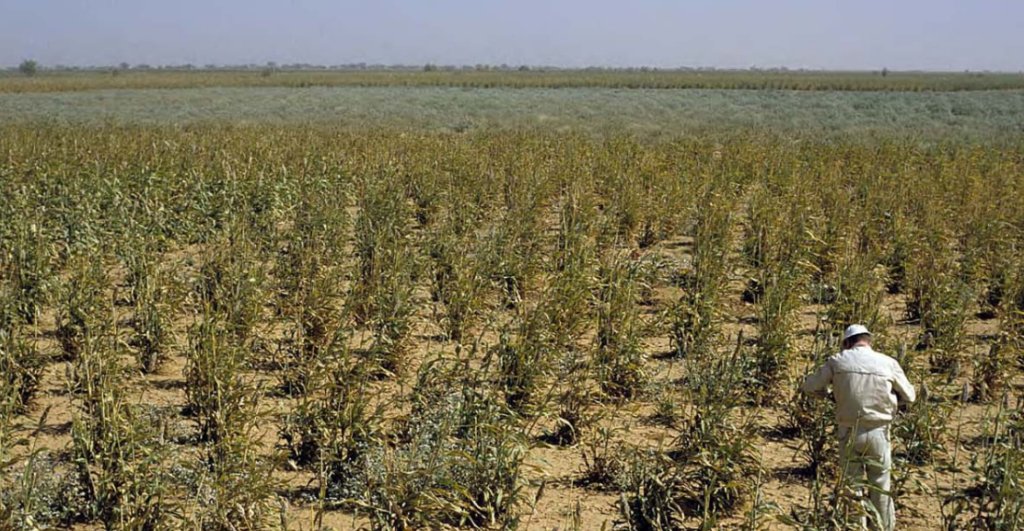
Both the quantity and nutritional value of plants is growing around the planet due to recent increases in carbon dioxide, claim the authors of an important new science paper. The recent rise in carbon dioxide during modern industrial times, from a period of dangerous denudation, is at the centre of worldwide fearmongering designed to enforce a Net Zero collectivisation. “In fact, the only clear result of increasing CO2 has been an overall greening of the Earth and increasing productivity of agricultural and forest crops,” state the authors.
Regular readers of the Daily Sceptic will be aware of the massive greening of the planet that has occurred over the last 40 years. Alas, this astonishing success story is inexplicably missing from most mainstream Net Zero-focused discourse. This latest paper is written by a group of scientists and published by the U.S.-based educational foundation CO2 Coalition. It is highly technical but it seeks to explain why the nutritional value of the world’s more abundant crops “can and will remain high as atmospheric CO2 concentrations increase towards values more representative of those existing throughout most of Earth’s history”. With CO2 levels considerably higher over most geological history, the current level of 425 parts per million (ppm) is much less than optimum for most plants, the experts observe.
For too long, note the scientists, atmospheric CO2 has been the nutrient in shortest supply holding back plant growth. “Rising atmospheric concentrations of CO2 have clearly been beneficial for the biosphere, agriculture, humanity and particularly for global food security at very low additional cost. Still higher concentrations will bring additional benefits,” they note. The CO2 Coalition, supported by the work of atmospheric scientists like Emeritus Professor William Happer of Princeton, has long argued that CO2 becomes ‘saturated’ at certain levels in the atmosphere. At higher levels its warming properties diminish rapidly. Due to this ‘saturation’, which helps explain why atmospheric CO2 concentrations been up to 20 times higher in the past without the planet turning into a fireball, “man-made CO2 emissions are not capable of triggering dangerous future warming”.
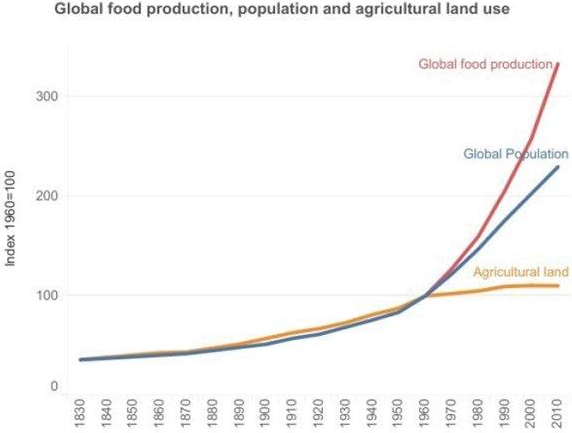
The great success of what is termed the ‘green revolution’ is shown above. The scientists note that important factors in the dramatic increase in food production have been increased atmospheric CO2, the development of greatly improved plant varieties and intelligent use of mineral fertilisers. The authors quote from a recent scientific paper, Taylor and Sclenker 2023, which states: “We consistently find a large CO2 fertilisation effect: a 1 ppm increase in CO2 equates to a 0.4%, 0.6%, 1% yield increase for corn, soybeans and wheat respectively.”
The evidence for greening of the Earth from atmospheric carbon dioxide “is now too obvious to deny”. The scientists publish the world map below to prove their point.
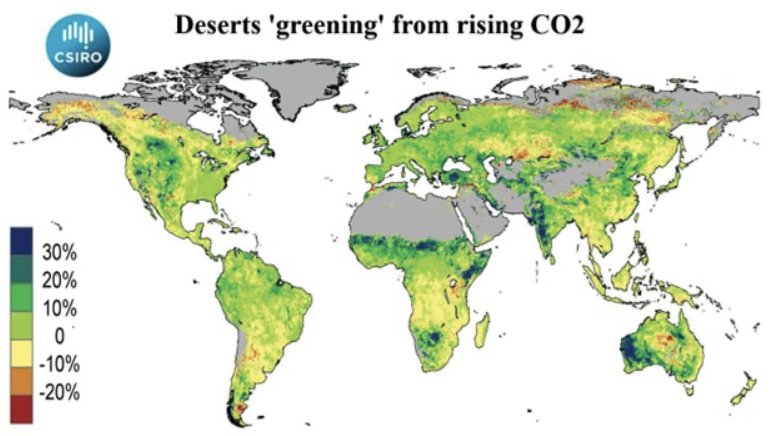
The above map was produced from satellite data recorded between 1982 and 2012. Greening by 20-30% was recorded in India, West Australia, the Sahel and the Anatolian highlands. Reference is also made to Chen et al. 2024, reported here in the Daily Sceptic, that found CO2 greening had actually accelerated over the last two decades. The increase in C02 was found to be the dominant driver of the positive trend of the Leaf Area Index over most of the global land surface.
Attempts have been made recently to downplay the benefits of more vigorous CO2-driven plant growth by suggesting it leads to a slight dilution of some nutrients, notably nitrogen, in plant tissues. In the course of their work, the authors state that these deficiencies are small compared with the nutritional shortages that agriculture and livestock face because of natural phenomena. “These problems have been routinely dealt with for generations through adequate fertilisation, proper species and cultivar selection, and food supplements for livestock and humans,” they argue.
The numerous desirable and beneficial effects of more CO2 in the atmosphere greatly outweigh ‘climate-damaging’ or ‘nutrient-damaging’ impacts, to the extent that these even exist. There is no ‘social cost’ of carbon, as is incorrectly claimed in numerous recent publications. In the course of their paper, the scientists say that have reviewed the literature and provided arguments that “arrive at quite a contrary view” to those who claim enhanced atmospheric CO2 somehow threatens human nutrition. “In fact, there is a social benefit from more CO2 in the air,” they conclude.
Chris Morrison is the Daily Sceptic’s Environment Editor.
The Green Agenda Will Lead to Civil War
By Ben Pile
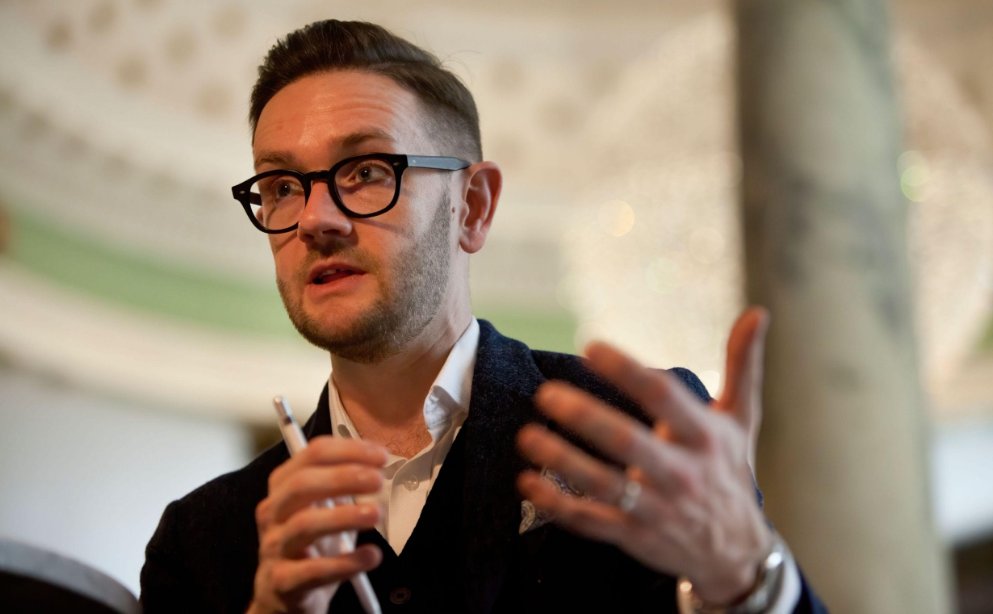
Chris Stark, the outgoing Chief Executive of the U.K. Climate Change Committee (CCC), is demob-happy. In a number of interviews, the highly-paid civil servant has criticised the Prime Minister for seemingly faltering in his commitment to Net Zero. This unguarded criticism is unusual in itself, unwittingly highlighting, rather than seeking to resolve, the increasing tensions between green ideological ambition and political reality. But it is Stark’s curious framing of the problems apparently holding climate policy back that is most revealing of the growing democratic deficit. The only things now sustaining the green agenda are the political establishment’s intransigence and sense of entitlement. And that increases the risk of catastrophic policy failure.
The CCC is a troubled organisation. Its former Chairman, pka John Gummer, now Lord Deben, left his role last year, and since then political disagreements between Westminster and the devolved governments have prevented the appointment of a permanent successor. Now, the CCC’s Chief Executive’s chair is also empty, and whoever steps into it has a much bigger set of problems to face than his or her predecessor.
This is all the more an irony because the CCC itself was summoned into existence by the Climate Change Act 2008 (CCA), which was the act not just of the dying days of the last Labour Government but also the expression of the cross-party consensus on climate change. MPs didn’t believe that they or their successors were able or should be free to represent their constituencies on matters of climate policies, and so only an ‘independent’ panel of experts – a quango, or Non-Departmental Statutory Body – would be able to set the terms of climate and energy policy, which the Act put beyond democratic control. Accordingly, the CCC has since its inception set the U.K.’s Carbon Budget. Now, however, the quarrelsome devolved parliaments – which were also created to bring all parts of Britain into harmonious consensus – and a growing sense of the impossibility of Net Zero makes it hard to fill the current vacancies. The pay is good, but you’d have to be daft to accept such a poisoned chalice. The climate agenda is literally out of control.
According to Stark in an interview with the BBC’s Laura Kuenssberg, the problem began last year when “Sunak delayed a ban on new petrol and diesel cars, and weakened targets on phasing out gas boilers”. However, as I argued at the time, the problem with this claim is that Sunak’s interventions were the smallest possible dampener on the policy agenda – a mild tapping of the brakes and nothing like a U-turn. The U.K.’s phasing out of petrol and diesel cars was, and still is, a target which reduces the proportion of internal combustion engine cars sold each year in stages. The change merely extended the last phase of this abolition from 2030 to 2035. By 2030, 80% of new cars sold will have to be EVs. Similarly, the 2035 ban on sales of new domestic gas boilers is largely intact, save for exemptions for low-income households. And properties that aren’t connected to the gas grid will not be required to shift to electric heating until 2035, because, as many argued, the previous target of 2026 was ‘premature’.
In other words, Sunak was attempting to save Net Zero, not depart from it. EV sales, for example, are rising only because of absurdly generous tax breaks given to well-off middle-class people, and have no chance of reaching 100% by 2030 without causing immense problems, as well as sacrificing a great deal more of the British and European car industry to China – a problem now acknowledged across the continent. Extending the target by five years was the only option available to the Government. And despite Sunak’s slightest possible dilution of the policy target, firms such as Vauxhall are now citing Net Zero, and the lack of consumer interest in EVs, as reasons for threatening to leave the U.K.
But Stark (who has done as much as anyone to salt the earth for his successor) attempts to catastrophise about Sunak’s decision in much the same way that civil servants have dramatised recent senior politicians’ decisions. “The diplomatic impact of that has been immense,” says Stark. “The overall message that other parts of the world took from it is that the U.K. is less ambitious on climate than it once was.”
This seems unlikely, and the plight of the U.K.’s poor climate diplomats facing the fallout from Sunak’s five-year extension should raise 67 million shrugs, if it is worthy of any attention at all. Diplomacy was not Stark’s or the CCC’s brief, and the notion of the PM derailing the global climate agenda by slightly undermining the world’s perception of the U.K. as a climate champion is only going to upset green wonks and the BBC and Guardian’s ideological hacks, not the hoi polloi.
In a subsequent interview with the Guardian, Stark’s attempt to rescue climate policy from inevitable watering down grew more obviously desperate. “Net Zero has definitely become a slogan that I feel occasionally is now unhelpful, because it’s so associated with the campaigns against it,” he told Fiona Harvey. “It’s the culture warriors who have really taken against it.”
It seems to be a tactic of people who believe in the genetic transfer of historical guilt and the interchangeability of biological sex – among other bizarre, unscientific things – to claim that anyone who disagrees with them, however reasonably, is waging a ‘culture war’. In this view, if you refuse to take a knee, or believe that gender-confused children ought not to be dispatched on irreversible medical pathways, then you are the dangerous activist. And the greens have embraced this tactic, believing that sceptics of climate science, and more pertinently climate policies, have simply joined the ranks of the ‘culture warriors’.
What the defenders of the radical progressive policies mean by ‘culture war’ is that they no longer have everything their own way. There used to be a cross-party consensus and widespread public support for our membership of the EU, various woke social policies and on the need to reduce carbon emissions. But the consensus has broken down and people who no longer have the ‘correct’ opinions on these issues are, understandably, seeking representation for their views. They’re not ‘culture warriors’.
Take the green agenda. The consequence of the abolition of petrol and diesel cars is not merely limiting consumer choice, but the restriction of mobility through price and technological limitation. The phasing out of the domestic gas boiler has an effect far beyond mere lifestyle – it requires a household to find many thousands of pounds, perhaps tens of thousands, to pay for a heat pump. And by seeking to prioritise the reduction of carbon emissions over maximising GDP, the successive U.K. Governments, the Treasury and the Bank of England, in cahoots with other central banks, have given enormous powers to financial institutions to regulate the economy and business activity via ESG, leading to a massive misallocation of resources, pushing prices up, with the main (perhaps sole) beneficiaries being green billionaires.
Stark, of course, will never have heard such criticisms. As far as he’s concerned, the prices of things are mere arbitrary numbers that can simply be controlled by yet another policy intervention to disguise yesteryear’s policy failures. Life is sweet when you’re a senior civil servant on a £400,000 package and your career is protected from markets and political whims. So what if energy prices double and double again, when you earn more than 10 times the national average? But such protection from reality means isolation from reality, too. His waving away critics as mere ‘culture warriors’ reveals that he – and the fawning journalists that surround him – lack even the vocabulary to understand criticism. Establishment hacks simply have no other term with which to explain the phenomenon of people disagreeing with them. It’s called democracy, Chris.
So if not a ‘culture war’, what is the right term for the divisions within society that are growing up around the climate agenda? I believe the correct term is ‘civil war’. Net Zero requires intensely political transformations of society – as radical as the changes sought by the early 20th century’s ideological movements. Net Zero requires the transformation of the relationship between the individual and the state. It requires the complete reorganisation of the economy. And it requires new powers to be created and put beyond democratic control.
It may not be a ‘hot’ civil war – or not yet. But our intransigent and chaotic political class seem not to have registered the possibility of their failure and have taken for granted our willingness to accept our immiseration ‘to save the planet’ without question or challenge. Much like many a military blunder, armies of wonks like Stark have no real idea about how to achieve Net Zero, nor what the costs and consequences of failure are, but will not be swayed from the agenda. Critics can just be written off as ‘deniers’ and ‘culture warriors’.
Under Chris Stark’s tenure, the CCC has lied, made stuff up, hidden its calculations from scrutiny and based its feasibility studies of the U.K.’s pathway to Net Zero on technologies that do not exist or have not been proven to be economically viable. And this was made possible by Parliament’s dereliction of its duty to scrutinise legislation and represent the public’s interests, and its desire to delegate difficult decisions to an unaccountable technocracy. Moreover, as Andrew Neil pointed out this week, this radical dismantling of democracy came with very little comment from the news media.
If the civil war is not yet apparent, it is because its battle fronts are not barricades, but remote agencies and lofty courts and financial markets. Their assaults on our freedom, wealth and ways of life are unannounced and greeted joyfully by journalists, while green activists protest that they’re not going nearly far enough. Our public institutions are captured and turned against us by legislation and legal precedent. Not by guns and bombs, of course, but the difference is merely one of rate: the difference between the speeds of combustion and metabolism. Either way, we get burned or eaten. Stark has quit his job at the CCC just as the reality of the Net Zero agenda has been made plain. This is a war of some kind, and it is bound to get hotter until politicians put the climate agenda to a full and proper democratic contest.
Subscribe to Ben Pile’s The Net Zero Scandal Substack here.
Sadiq Khan Under Fire for Suggesting Chief Rabbi’s Criticism of his Gaza Ceasefire Call Was Down to his Muslim-Sounding Name
By Will Jones
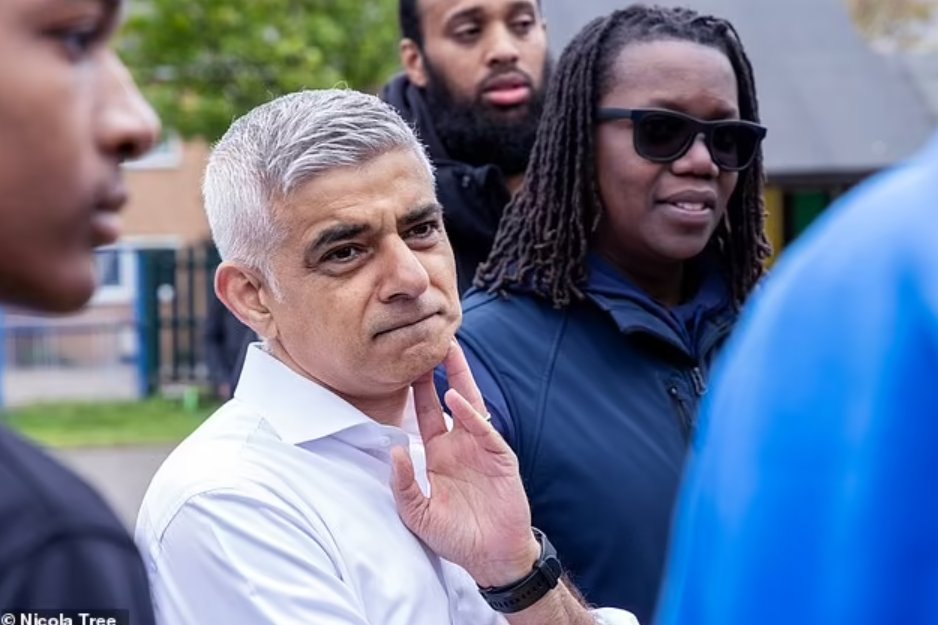
Sadiq Khan has apologised for suggesting the Chief Rabbi’s criticism of his call for a Gaza ceasefire was due to his Muslim-sounding name. The Mail has the story.
The London Mayor revealed he had said sorry after venting his frustration during an interview about the backlash he faced.
Speaking to journalist Mehdi Hasan earlier this week, Mr. Khan had argued that there had been no equivalent response when Manchester Mayor Andy Burnham called for an immediate ceasefire.
Mr. Khan said: “What motivated them to come out in the way they did against the Mayor of London, and the Mayor of Greater Manchester – I’ll give you a clue, he’s not called Ahmed Bourani, he’s called Andy Burnham, whereas I’m called Sadiq Khan.”
After the issue was raised in the Jewish Chronicle today, Mr. Khan posted on social media: “The Chief Rabbi, along with other Jewish leaders, has been a friend to me, and we have worked hard together to unite our city and celebrate our diversity.
“I have been in contact with the Chief Rabbi to apologise for my comments.”
In a statement to the JC, the Mayor added: “At times it is clear to me, and others, that as a Mayor of London of Islamic faith, I am held to a different standard and that can be frustrating – particularly during a divisive election campaign.
“But, it wasn’t fair of me to have levelled that frustration at the Chief Rabbi. I am sorry for any hurt this has caused and will continue working with Jewish leaders to build a safer London for everyone.”
Worth reading in full.
Reports of the Demise of the Scottish Enlightenment May Have Been Premature
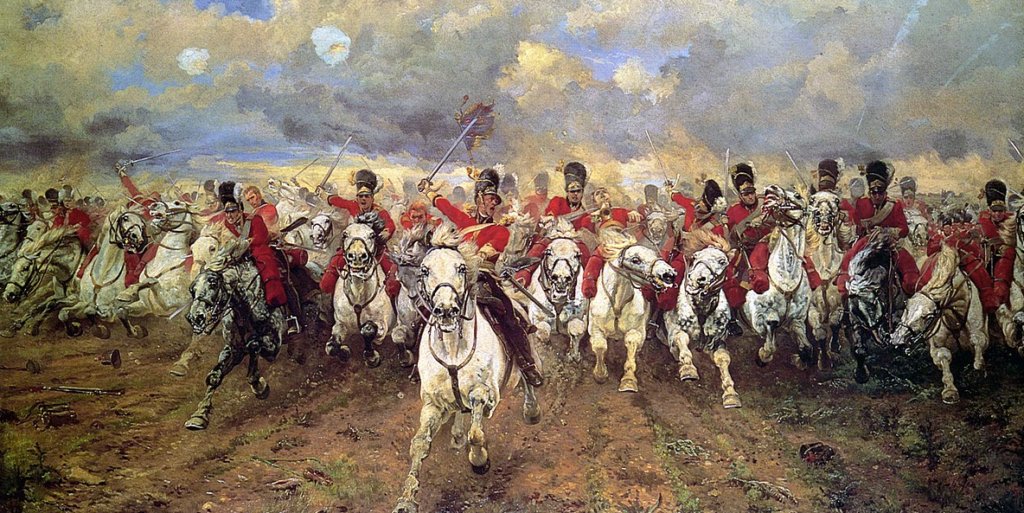
Well, it’s not even a month since I wrote that Scotland’s Hate Crime Act marked the death of the Scottish Enlightenment by alluding to the barbaric execution of Thomas Aikenhead for blasphemy in 1697, and it looks like rumours of its demise may have been premature.
This isn’t completely down to the machinations of the MSPs, despite a few heroic efforts on the Tory and Alba benches, but rather to the wonderful, stubborn and doughty people of Scotland.
Now the Scots have many faults. I can say this because I am one of them. We are too quick to anger, our character has been influenced both positively and negatively by living in the shadow of a more powerful nation to the south, the latter expressed by a degree of insecurity we are all born with. We have our issues with sectarianism and have enough Celtic blood (together with Norse, Angle and Briton) to hold the blood feud of tribalism close to our hearts. (That’s Hearts, not Hibs… you see: tribalism!)
However we have some virtues and one we’re also rightly proud of is that we are a free people. This last point is often glossed over with Mel Gibson in a wig memes. However, it has a serious point, which goes way back to the Declaration of Arbroath in 1320. For my Saxon readers this was a letter sent to the Pope from the lords temporal and spiritual of Scotland (speaking on behalf of the people) in response to the excommunication of their King, Robert Bruce. The document conveniently ignores the reason for the excommunication, Bruce’s murder in a church of John ‘The Red’ Comyn in 1306, and instead argues for his communion with the Church on the basis that he is the King of a free and ancient people.
The particular words that are branded on the backside of every Scottish baby (figuratively speaking) are:
[Now, the context of these words was independence from England, in particular, independence from both the English Crown and the See of Canterbury. However, like that other great document of the British People, Magna Carta, the meaning and significance of the declaration has changed over time.It is in truth not for glory, nor riches, nor honours that we are fighting, but for freedom alone, which no honest man gives up but with life itself.
‘Freedom’ changed after the emergence of the modern state of Great Britain in 1707, the union of two equals, the most successful union of two nations or peoples in the history of the world. Bereft of her seat of government, the intellectuals of Edinburgh threw themselves into philosophy, jurisprudence, science, engineering, medicine, art, architecture, economics and education. The light of the Enlightenment blazed brightly from this small northern city with a fervour that eclipsed others and which still shines to this day. ‘Freedom’ was no longer the freedom from England – union made that superfluous – it was freedom of thought, of speech, of ideas and conscience. This freedom fuelled the ideas that changed the world.
One of the things that non-Scots misread about us is to assume that our national pride comes from Mel Gibson, Robert Bruce and a thousand battles fought against Saxon, Norseman and, most often, each other. The main source of our pride actually comes from the huge contribution Scotland has made to the world, yes, it was spread by the Empire and the union with England, but it had to start somewhere. Arthur Herman’s somewhat tongue in cheek book How the Scots invented the Modern World makes this point. Modern economics, medicine, engineering and philosophy owe an awful lot to Scotland, never mind the inventions that poured out of Scots that have changed the world from the telephone to the television, tarmac, penicillin and even the Bank of England. Yes, we may get maudlin over a glass of the Water of Life about the heroes of old, but we are just as likely to get maudlin over our 1978 World Cup run. No, what Scots are most proud of, what is baked into our DNA is the huge contribution made to the modern world by a hairy, argumentative, somewhat aggressive, often resentful and frequently ginger haired people.
So it was this people whom Mrs Sturgeon and Mr. Yousaf fatally misread when they tried to do that very thing that the Scots despise more than anything else: take away their freedom.
No, not their freedom from mortgage, from responsibility, but the freedom to think, to ‘chew the fat’ (debate) and to ‘blether’ (talk). Mr. Yousaf decided to threaten this with spurious arguments around ‘harmful speech’. He wanted to sell our 400 year birthright to feather his own ego under the disingenuous claim that nasty words cause ‘harm’.
You would have thought that Yousaf would have known that ‘freedom’ is a thing very dear to the hearts of Scots. That we pride ourselves on being able to have robust debates in our pubs, no topic off piste, and to stagger home arm in arm at the end of the night, preferably past a chip shop for a deep fried haggis supper!
So it has been wonderful to see how the Scots reacted to the tyranny of the Hate Speech and Pubic Order Act 2021 (Scotland). Essentially with a colossal, national raspberry combined with the symbol of archer’s defiance borrowed from our English cousins: the two fingers!.
First off, the wonderful J.K. Rowling laid down the gauntlet – telling Police Scotland that they’d better come and arrest her as she wasn’t going to curtail her opinion. She followed this up by tweeting that if any woman was arrested for speaking her mind she would exactly mirror her words and share her fate. Before the Act had even gone live, she had trashed it, exposed it as unenforceable rubbish and, in the best Scots tradition stated those words dear to every British football fan: “Come and have a go if you think you’re hard enough!” The Police whimpered in response.
Then came the complaints against Humza himself. Doing a bit of ‘offence archaeology’, thousands of Scots swamped the ‘Grass Lines’ with complaints about Humza and his appalling speech in the Scottish Parliament where he appeared to have a problem with ‘Huwhite’ people. So many complaints were made that Police Scotland issued a script to the call handlers claiming that the speech was not racist. But wait – racism is in the eye of the beholder, it doesn’t matter what the Peelers think, it’s whether or not the victim feels they have been abused. Offence is in the power of the offended and they don’t get to decide for us what we find offensive or otherwise. Of course, this was greeted with glee at the clumsy hypocrisy as the hapless Yousaf was once again hoist with his own petard.
So overwhelmed were the ‘polis’ by the number of people reporting mates from the pub, dogs from defecating on their lawn, deliberately out of context statements by celebrities that they had to say they were no longer going to investigate a slew of actual crimes. Their laughably childish promise to “investigate every instance of hate reported” was proven to be impossible to meet, as they were warned by anyone with a modicum of common sense. In fact, this is a thread throughout this whole sorry incident. It should have been no surprise to the SNP that this law would be as much of a disaster in its implementation as it was in its drafting. They were warned, repeatedly, by the ‘hiheidyins’ (bosses) of the Scottish Legal system and by Police Scotland, and yet they went ahead anyway. The arrogance and hubris of Mr. Yousaf and his Government as they paddled their canoe towards the rapids, ignoring calls to stop has been remarkable, particularly as the rapids are of their own making.
Then this week the figures are in. The Free Speech Union tells us that since the law went live on April 1st, 0.6% of reports have been recorded as actual crimes: 9,374 incidents were reported since April 1st with only 616 recorded as possible hate crimes and merely 79 as ‘Non Crime Hate Incidents’. That last figure is interesting because police guidance states that any incidents not found to be crimes should be recorded as Non Crime Hate Incidents. So why are Police Scotland not doing this? Could it be that they have abandoned their own guidance a mere three weeks into the farce?
I don’t want to beat up Police Scotland too much here. They were given a hospital pass by the SNP Government, one which they never wanted and indeed objected to as deeply flawed and unenforceable in a nation that polices by consent. It seems extraordinary that the SNP Government seems to be at a loss to understand what that means, ‘policing by consent’, and the damage to the authority of the police through making hapless plod a laughing stock of the nation.
So I was wrong. It seems that it will take a lot more than ham-fisted, ideologically captured, arrogant in their certitude and deeply ignorant of the mood and culture of those they profess to govern to destroy the Scottish Enlightenment. No, that is in safe hands, the hands of the Scottish People who will fight “for freedom alone, which no honest man gives up but with life itself”.
C.J. Strachan is the pseudonym of a concerned Scot who worked for 30 years as a Human Resources executive in some of the U.K.’s leading organisations. Subscribe to his Substack.
The Push for Global Censorship in Australia
Like Emily Blunt’s character in The Devil Wears Prada, who was “just one stomach flu away from goal weight”, the Australian Government was just one emergency away from manufacturing consent for its widely panned misinformation bill… until now.
In the wake of two violent stabbings in Sydney, one of which claimed six lives at a shopping mall, and the other of which was live-streamed during a church service, senior politicians and bureaucrats are promising to ramp up social media censorship to protect Australians from misinformation and violent content online. (A third stabbing on the same weekend resulting in the death of a Sydney teen has been omitted from the discourse around censorship, probably because it wasn’t filmed.)
Two narrative threads dominating the media cycle underpin the renewed calls for censorship.
The main plot is a stand-off between Elon Musk’s platform X and Australia’s eSafety Commissioner, Julie Inman Grant over footage of the non-fatal church stabbing. The incident was classed as a terrorist incident by the New South Wales police, giving Inman Grant the legal power to order the footage removed from social media sites within Australia.
X says it has hidden the footage from Australians, but refuses to comply with a further demand to withhold the footage globally. Apparently the order for a global ban is to prevent Australians from using VPN technology to circumvent an Australia-only geo-block. eSafety says X isn’t doing enough to protect social media users from the violent content, and has obtained an injunction from the Federal Court to force X’s hand.
The subplot is the mis-naming of the Bondi Junction mall attacker, spread first on social media, then amplified with apparently zero attempt at verification by major news station Channel 7, with the wrongly named man now suing the station for defamation.
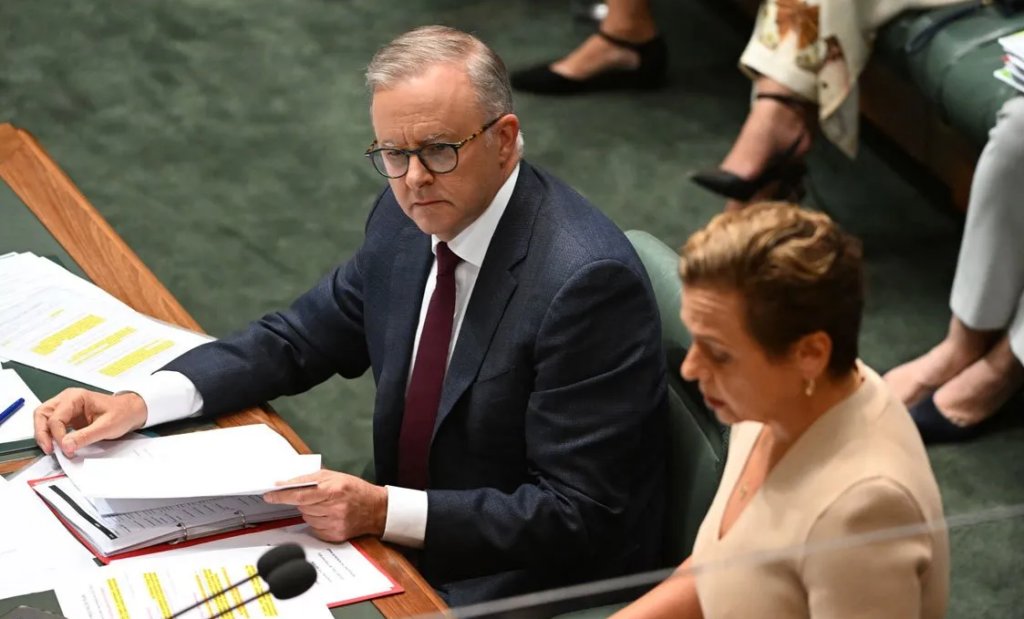
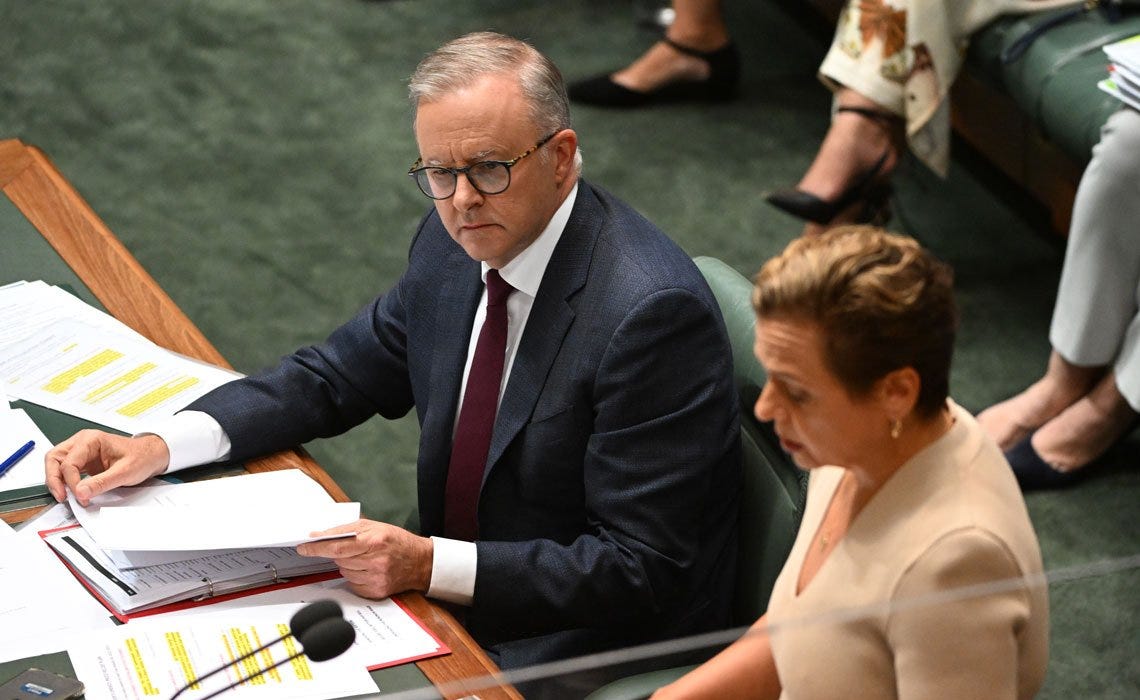
At a press conference on Monday, Prime Minister Anthony Albanese blamed social media companies entirely for spreading the damaging rumour, omitting mention of the corporate media’s role.
From these events, Australia’s top politicians and bureaucrats have drawn the following conclusions:
- Inman Grant should be backed 100% in her attempts to censor content globally (says Deputy Opposition Leader Sussan Ley)
- Social media platforms have a “social responsibility” protect Australians from content that might “cause division” (says Prime Minister Anthony Albanese)
- Elon Musk is “totally out of touch with the values that Australian families have” and is causing Australians “great distress” (again, Albanese)
- Social media companies are “pouring accelerant on the flames” of misinformation and extremism (says Australian Federal Police Commissioner Reece Kershaw)
- In fact, social media is responsible for “just about every problem” in society, leaving governments to “pick up the pieces” (says Home Affairs Minister Clare O’Neil)
- Therefore, the only responsible action for the Government to take is to revamp its shelved misinformation bill in the hope of preventing “dangerous falsehoods” from spreading “at scale and speed” (says Communications Minister Michelle Rowland)
- Indeed, our politicians are “prepared to take whatever action is necessary to haul these companies into line” (says Albanese)
- Even the opposition party, which until now had vigorously opposed the misinformation bill, is prepared to back the laws and “happy to look at anything the government puts forward” because social media companies “see themselves [as] above the law” and we need to show them they’re not (says Liberal Party leader Peter Dutton)
Currently, the main way the Australian Government controls the internet is under the remit of the eSafety Commissioner, who is empowered to minimise online harm. The Commissioner can order the removal of child abuse content, revenge porn or a recently added category, “adult cyber abuse”, which has resulted in the removal of gender-critical posts on social media. Read more about the eSafety Commissioner and her role in the global censorship network in my recent collaboration with Network Affects, here.
However, the Government has little control over online content outside of eSafety’s remit. During the pandemic, the Department of Home Affairs and the Department of Health exploited the emergency to co-ordinate the removal of content on social media sites, including memes, true information and vaccine injury testimony, but that gravy train has ended.
This year, the World Economic Forum (WEF) named mis- and disinformation as the world’s most pressing threat – more than war, more than hunger, more than poverty.
Governments are increasingly looking for ways to solve the problem that global elites have decided tops the list of all possible problems. In Australia, the solution put forward is a misinformation bill that would give the government new powers to set and enforce industry standards for digital platforms.
The issue is, the bill was deeply unpopular when it was floated for public consultation last year, attracting 23,000 comments, including 3,000 submissions. Many of the submissions were critical of the proposed laws, which would have the effect of censoring a staggering range of speech on issues from the weather, to elections, to public health, to gender ideology and so on.
Notably, the Government and mainstream media are exempt from the proposed laws.
Even the Human Rights Commission, which completely dropped the ball during Covid, claimed that the bill was a risk to democracy. Human Rights Commissioner, Lorraine Finlay said of the bill:
If we fail to ensure robust safeguards for freedom of expression online, then the measures taken to combat misinformation and disinformation could themselves risk undermining Australia’s democracy and freedoms.
An article I wrote for Umbrella News last year, titled, ‘Australia on ‘Dangerous Ground’: Is the New Misinformation Bill a Threat to Democracy?’ echoes Finlay’s concerns.
But flick through news coverage over the past fortnight and you’ll find that dissent over the bill is just a distant memory, because no one is safe until we’re all safe.
Corporate media are gleefully playing the story as Australia vs. Musk, throwing their full weight behind the Government, while politicians and top bureaucrats are taking every talk-to-the-press opportunity to push the bill as a necessary measure to bring errant social media platforms to heel.

At the same time, in the parallel digital universe of X where Musk holds forth, people are wise to the Government’s cynical ploy, and that far-Right-wing-white-supremacist-Nazi tactic of telling jokes is doing its work.
What kind of misinformation does the Prime Minister Albanese think social media companies have a responsibility to censor? Photoshopped memes of himself, a year-old video reveals.
The internet responded accordingly, spawning a tonne of new Albo meme threads overnight.
Ironically, the life-as-meme ridiculousness was foreshadowed by Senator Pauline Hanson, who reposted a July 2023 video from her cult Please Explain series, featuring a cartoon Albo trying to get the misinfo bill passed so that he can censor memes of himself. Fifteen-year-old me could never have imagined that Senator Hanson would turn out to be Australia’s number one troll, but here we are.
Less funny is the discussion taking place around glaring double standards in the way the Australian Government goes about the business of censorship.
The Australian journalist Adam Creighton notes that propaganda scaring the public with fake virus death scenes is fine, but real news is not.

Independent journalist Maryanne Demasi points out that no one called for censorship of recently circulating footage of a man setting himself on fire in public, or of footage of George Floyd’s dying moments in 2020.
Left-wing Australian news site Crikey describes Elon Musk as a “vile piece of work with a penchant for extreme right-wing views”, but nevertheless called the corporate media, with its “if it bleeds it leads” modus operandi, “deeply hypocritical” for savaging Musk over his refusal to comply “with Inman Grant’s view that she should determine what anyone in the world can see online”.
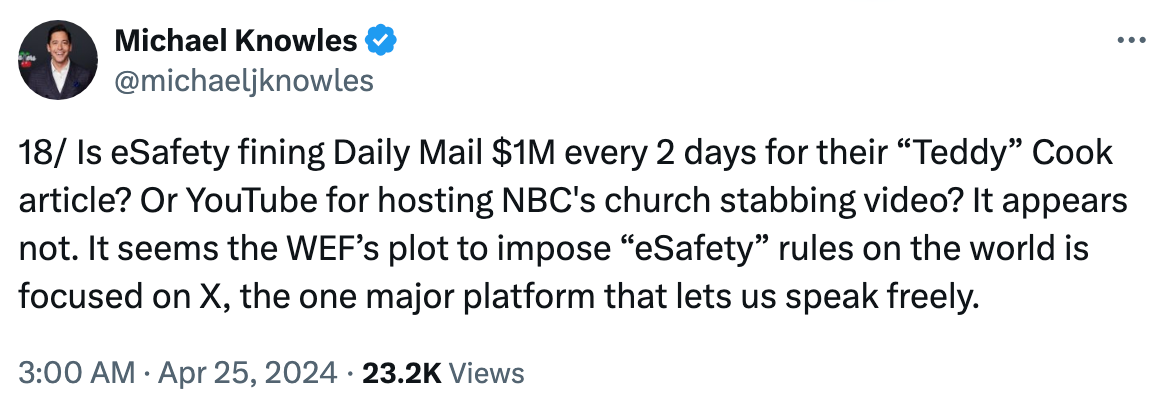
And on the right, Daily Wire commentator Michael Knowles points out that mainstream media received no fines or take-down notices for publishing the news story featured in a post on X recently censored by eSafety – so is this regulatory pursuit of posts on X about the content, or is it about going after X?
Besides, it’s misleading to imply that the choice is “censorship or nothing”, argues digital rights expert (and my recent collaborator) Andrew Lowenthal. Speaking with Demasi, he said, “I think there are non-censorship ways of addressing community concerns”, such as suggesting warning labels or disabling auto-play so viewers can decide whether to view the content or not.
In a comic narrative turn that could have been lifted from a Fawlty Towers script, the victim of the church stabbing, Bishop Mar Mari Emmanuel, has now declared that he disagrees with eSafety’s censorship of the footage of the attack on him, warning against the incident being co-opted for political gain.
In a statement posted to YouTube yesterday the Bishop, who is recovering in hospital, said:
I do not condone any acts of terrorism or violence. However, noting our God-given right to freedom of speech and freedom of religion, I’m not opposed to the videos remaining on social media. I would be of great concern [sic] if people use the attack on me to serve their own political interests to control free speech.
Nevertheless, Australia’s political class is unlikely to let this emergency go to waste. The eSafety Commissioner has the full-throated support of the Government to continue her online censorship crusade, and the misinformation bill is currently being overhauled, to be tabled again later this year.
My sincere thoughts and prayers go to those who have suffered due to the knife attacks in Sydney this month.
Update: In the latest news, opposition leader Peter Dutton has tempered his support for unbridled censorship, telling 2GB radio that the Government cannot be the “internet police of the world”. However, he maintains support for the eSafety Commissioner’s actions within Australia, and for working with the Government to legislate the misinformation bill later this year. My guess is that his strong pro-censorship statements from earlier this week didn’t land well with his conservative base, and so he has softened messaging accordingly.
This article was originally published on Dystopian Down Under, Rebekah Barnettt’s Substack newsletter. You can subscribe here.
News Round-Up
By Toby Young

- “You need a TV licence to watch Netflix — and you risk fines of £1,000 for not having one” – By offering live broadcasts, Netflix will add an extra £169.50 to subscribers’ costs, reports GB News.
- “‘The Great Covid Panic’ Book” – Author, publisher and academic Dr Tom Christie interviews Dr Colin M. Barron about his recent book ‘The Great Covid Panic’ on YouTube.
- “John Cleese: Basil Fawlty would be bewildered by the country England has become – and so am I” – As Fawlty Towers comes to the stage, its creator considers what has changed – from trans athletes to trigger warnings – and how BBC comedy lost its way, reports the Telegraph.
- “Feminism has left middle-aged women like me single, childless and depressed” – Petronella Wyatt says she was taught to prioritise her career over marriage – and now she‘s paying for it, according to the Telegraph.
- “Cleverly: Khan talks more about Gaza ‘than black kids getting murdered in London’” – The Home Secretary has accused the Mayor of London of being ‘asleep at the wheel’, reports the Telegraph.
- “Elon Musk vs the globalist censors” – Australia’s demand that X take down a violent video clip in every country, not just Australia, is absurdly authoritarian, says Brendan O’Neill in Spiked.
- “Sadiq Khan apologies over swipe at Chief Rabbi in interview” – Sadiq Khan revealed he had said sorry after venting his frustration during an interview about the backlash he faced, reports the Mail.
- “The burden of HR red tape is becoming untenable for small businesses.” – EDI/DEI is the last straw from British businesses straining under the burden of bureaucracy, says CJ Strachan.
- “Bird flu virus found in one-fifth of US milk samples, testing shows” – Early results from sampling study suggest bird flu could be widespread in America’s commercial supplies, says the Telegrah.
- “Ireland can’t blame the Rwanda plan for its immigration woes” – ‘When in doubt, blame Britain’ has, since Brexit, become something of an iron law of Irish politics. So it came as no surprise yesterday to see Michael Martin, Ireland’s deputy prime minister, attribute Ireland’s mounting migration crisis to Britain’s Rwanda scheme, says Michael Murphy.
- “Christian parents lose bid to send disabled son to Italian hospital” – The boy, who was born with serious disabilities and cannot see or hear, has been kept alive by life support machines at London ‘s King’s College Hospital since 2023,
- “NatWest rushes out debanking rules after Nigel Farage scandal” – Bank extends closure notices ahead of legislation coming into force in the summer
- “The BBC is blinded by its bias against GB News” – The Today programme hosts can’t stop taking shots at our fledgling broadcaster, forgetting that this kind of prejudice is why it was created
- “BBC removes Laura Kuenssberg episode after complaint over Chris Packham comments” – Edition taken down from iPlayer after claim of ‘false and defamatory’ allegations
- “Sunak is right to put Britain on a war footing. Its meaning goes beyond defence” – The PM’s Warsaw speech was welcome because it recognised just how serious the danger now is
- “Britain must brace itself for a wave of nationalisation” – Labour’s plan to control swathes of the economy is hiding in plain sight
- “Tony Blair’s great devolution experiment has been an unmitigated disaster” – Instead of resulting in better governance, it has elevated to high office a series of inadequates
- “What is the ‘Woke Right’?” – Lately I keep hearing the phrase ‘woke right’. Apparently coined, or at least promulgated, by Konstantin Kisin. It’s a catchy term, but what does it actually mean? The obvious implication is that elements of the right are now the same as—or perhaps more accurately ‘as bad as’—the woke left. The idea that the furthest reaches of the left and right meet up in a circular fashion is of course nothing new, as Konstantin covers in
- “ONS civil servants refuse to return to the office for two days a week” – The union argues that staff have proven their ability to work flexibly and attempts to remove that right are unfair
- “Hundreds of UK’s brightest students denied chance to train as doctors” – More than 1,550 Britons with at least three A*s have been refused a spot at medical school over the past five years, officials have revealed.
If you have any tips for inclusion in the round-up, email us here.









Profanity and abuse will be removed and may lead to a permanent ban.